Understanding the links between energy access and climate change adaptation
2021 was a crucial year for the climate agenda. It is now ‘unequivocal’ that humans are driving climate change. [1] Yet, despite some positive outcomes, COP26 was largely disappointing as we are still on track for 2.4°C of warming by 2100. [2]
Worsening climate change is damaging lives, livelihoods and the environment -disproportionately in the global south- and undermining progress towards the Sustainable Development Goals including SDG7: universal access to modern energy by 2030.
The relationship between energy access and climate change adaptation is often overlooked in policy and practice. [3] However, understanding this relationship is vital to achieve both SDG7 and effective adaptation in the face of climate change.
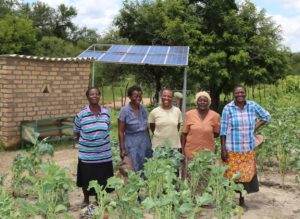
Solar-powered irrigation on a farm in Zimbabwe
Broadly, the relationship has three dimensions:
- Climate impacts affect energy access by reducing energy availability and accessibility, and increasing drudgery for those involved in energy resource collection (with women and girls often worst affected). [4]
- Adapting energy systems, for example, by diversifying energy sources, increasing the distribution of energy solutions and adopting technical improvements to reduce systems’ climate vulnerability. [3]
- Energy access to facilitate adaptation by supporting socio-economic development (increasing incomes, health and education etc) or enabling specific strategies such as water pumps for irrigation; biogas digesters providing organic fertiliser; and clean cooking solutions to reduce firewood use protecting forest-based adaptation services.
Practical Action promoted the role of energy access in facilitating adaptation at COP26 during the SDG7 Pavilion (see 44: 20) and Locally Led Adaptation Hub. Both events discussed opportunities and challenges in using renewable energy to reduce climate vulnerability. The former brought in expert views from GOGLA, FAO, and IKEA Foundation and the latter promoted the use of renewables to support ‘ecologically sound’ regenerative agricultural practices such as reduced tillage, intercropping and cover crops.
Renewable energy can enable ‘triple wins’ for energy access, mitigation and adaptation. As climate impacts worsen, rising energy demand for adaptation threatens mitigation targets if it is met using fossil fuels. However, using renewable energy solutions, such as solar PV, can achieve mitigation co-benefits in terms of reduced or avoided emissions. Another advantage is more efficient and holistic use of limited climate finance. [5]
Co-benefits are desirable, but risks and trade-offs must be considered. For instance, energy production can limit space for other land uses needed for adaptation such as food production and housing. [5] Specific adaptation strategies also have risks: solar water pumps for irrigation can enhance water scarcity if extraction rates are unsuitable. Therefore, interventions can be climate change maladaptive (inadvertently increasing climate vulnerability) without consideration of risks and trade-offs at planning stage.
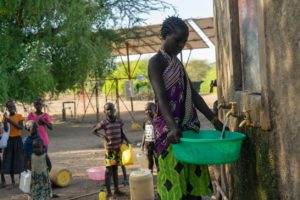
Communities in drought-prone Turkana accessing drinking water from a solar-powered water point
Going forward
As an organisation, our experience in both the energy access and climate change adaptation fields makes us well placed to integrate the two within our work. To achieve outcomes at scale, we will also promote energy access as a key component of adaptation to other actors operating in the climate and energy access sectors. More announcements will follow as we develop our combined approach over the coming months.
In the meantime, you can learn more about our role in energy access and climate change adaptation (including our combined approach) by visiting the Practical Action news page.
References
- Rannard, G. COP26: World headed for 2.4C warming despite climate summit – report [Internet]. London: BBC. 2021 [cited 2022 Jan 21]. Available from: https://www.bbc.co.uk/news/science-environment-59220687
- Intergovernmental Panel on Climate Change (IPCC). Climate Change 2021 The Physical Science Basis Summary for Policymakers [Internet]. Geneva: IPCC. 2021 [cited 2022 Jan 21]. Available from: https://www.ipcc.ch/report/ar6/wg1/
- International Renewable Energy Agency (IRENA). Bracing for Climate Impact: Renewables as a climate change adaptation strategy [Internet]. Abu Dhabi: IRENA. 2021 [cited 2022 Jan 21]. Available from: https://irena.org/publications/2021/Aug/Bracing-for-climate-impact-2021
- International Energy Agency (IEA). Africa Energy Outlook 2019 [Internet]. Paris: IEA. 2019 [cited 2022 Jan 21]. Available from: https://www.iea.org/reports/africa-energy-outlook-2019
- Energy and Environment Partnership (EEP). Energising Resilience Climate Co-Benefits from Clean Energy Projects [Internet]. Johannesburg: EEP. 2021 [cited 2022 Jan 21]. Available from: https://eepafrica.org/wp-content/uploads/2020/11/Energising-Resilience_digital.pdf