• Improved stoves in Sudan help combat climate change

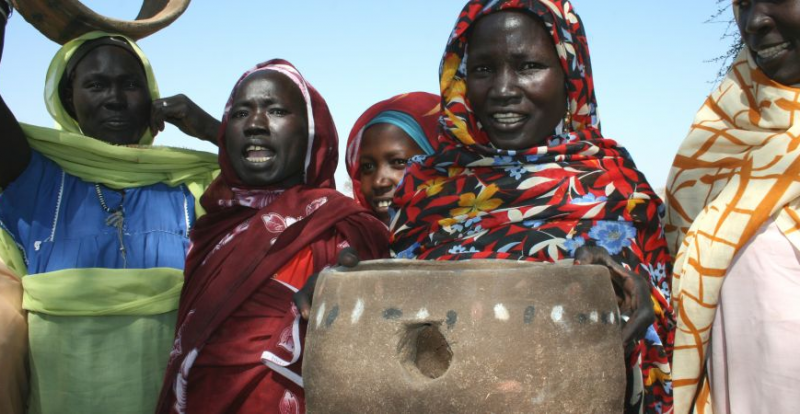
    In North Darfur, we are running a project of low smoke stoves, funded by Carbon Clear. It is benefiting thousands of families in that arid region who now have a clean kitchens, clean lungs and more money to spend on essentials. The project is also helping the environment because the stoves produce less carbon emissions.

    Supra

    Carbon credits delivering sustainable development

    It is the first ever carbon credit programme to be registered in Sudan, registered by Gold Standard Foundation, so it is generating carbon credits to deliver more sustainable development in that region.

    The process of registering a project within the CDM Clean Development Mechanism, of the Kyoto protocol, is not easy, but it is possible and achievable.

    Climate change – people in Sudan are paying the price

    Sudan is a country severely affected by the climate change. People there are paying the price for the actions of other people that contribute to climate change. As a result, most of these people are obliged to adapt their lives accordingly. But this project goes beyond adaptation.

    How? Because these people are mitigating carbon emissions in a similar way to the way blue chip companies  ought to be ; but here they are acting voluntarily; reducing emissions from their daily cooking activities, and playing another role of offsetting by greening the deserts through what we call community forests.

    Such good work and hearted wills and spirits are getting paid instantly in the form of:

    • better health;
    • cleaner kitchens;
    • saved income;
    • less time collecting fuel and more spare time to take part in social activities.

    Of course, there are also positive impacts on the environment!

    No Comments » | Add your comment
  • Dying for a drink in Turkana, Kenya

    I’m writing from Practical Action’s office in Lodwar, Turkana having returned from an intense three days in the field visiting our water and sanitation projects here. I’m particularly interested in how our solar powered pumps are improving the lives of the Karamoja people who we’re working with.

    First of all, I have huge respect for these proud people. Turkana is Hot! Every day the temperatures soared above 35 degrees, and at night things cool down to a balmy 25 … The environment is harsh – dry sandy soil, a few scrubby bushes and acacia trees, very little water. The fact that they make any living at all here is testament to their toughness, determination and ingenuity. I also have to thank them for their hospitality. I slept under the stars in the chief of the Lobei Karamoja’s compound disturbed only by gunfire (once) and cockerels (lots).

    I’m dirty and dehydrated but what I’ve seen really makes think about what ‘dying for a drink’ really means.

    In Turkana there are 3 ways to die for a drink …

    1 … From the dirty contaminated water that most people are forced to drink – hand scooped holes in dry riverbeds many miles from home are the most common water source and they are shared with animals. Cholera is common here.

    2 … In the act of collecting water from 5-metre-deep pits, hand-dug in the sandy bed of a dried up river – these collapse regularly, and last week in Lorengippi 3 people died collecting water in one of these.

    3 … Or by violence – water, even dirty, contaminated water, is so precious here that people guard their access rights forcefully. I watched two women and a girl lifting water from the bottom of the pit for their goats and donkeys – all the while watched over by two warriors with loaded guns.  Come to collect water at the wrong time here and you will be risking your life.

    But things are changing in Lobei and now in Lorengipi. In October last year Practical Action, working in partnership with the people of Lobei, installed a solar pump, pipes, storage tanks and tap-stands so that now the women and girls have to walk no further than 500 metres to collect the water they need. Specially constructed troughs have been built to water the animals, meaning now that they don’t share a water source with people. Girls are now able to go to school, and in Lobei, the number of girls enrolled at the primary school exceeds that of boys for the first time. The head-teacher there is a trailblazer in many ways – one example was his kitchen garden and we saw the first ripe maize picked as we visited. So much change in so short a time.

    In Lorengippi I watched as a new solar pump was installed, storage tanks raised and tap-stand built. For this community, water is a life and death matter. Conflict over water here is common. The boarding school has existed here since the late 60s. Children board as it is too dangerous to walk back and forth. In all those 40+ years the school has never been connected to water and never had latrines. Pupils walked 3km to collect water for breakfast and again for dinner, each time risking their lives to get it, and their health by drinking it. Open defecation in the fields surrounding the school was common, and the whirlwinds and seasonal rains brought all the faecal dust back into the school. Illness was common, learning didn’t happen and exam results suffered. Now the school is connected to the solar system, water is on tap at the school and new latrines have been built for boys and girls. Small, but important changes for these children, yet dramatically impacting their future.

    I need to stop writing now, the sun is overheating my laptop and I need to get a drink before sunstroke sets in … I’m going to be thinking more carefully about where that drink comes from now.

    2 Comments » | Add your comment
  • A MEGA initiative in Malawi

    Drew Corbyn
    May 16th, 2013

    Practical Action are working with our partners in Malawi to establish MEGA – a sustainable and ambitious social enterprise delivering green mini-grids to poor rural communities.

    It is estimated that 587 million people in Africa alone are without electricity.  And as population growth outpaces the number of people getting access to electricity on the continent, this number continues to rise.  Furthermore, it’s estimated that 55% of people without electricity will be best served by decentralized technologies such as mini-grids and standalone systems.  A step-change is needed to meet this challenge; with greater focus on off-grid technologies, innovative business models and smarter investment.

    Malawi and Mozambique 022The MEGA initiative is in Malawi, where 85% of the 15 million population lives in rural areas, of which only around 1% has electricity – there are 12.6 million people, countless businesses and numerous health centres and schools without electricity.

    The government has an active rural electrification programme, although the focus on national grid extension and the all too limited resources leave many areas in Malawi with little hope of having electricity in the near future.

    Decentralized energy programmes and business models that can achieve scale and sustainability are few and far between in sub-Saharan Africa – and Malawi is no exception.

    Many installed mini-grid schemes in developing countries are plagued by failures and struggle to sustain operations.  Sound financial plans and real diligence are required to ensure that funds are available for the day that essential component breaks and needs replacing.  Skilled technical expertise to diagnose problems and obtain and install replacement parts is another critical element that is particularly challenging in remote rural areas.

    MEGA – Mulanje Electricity Generating Authority – is tasked with stepping into this gap.  MEGA will bring together professional, financial and technical expertise that can ensure project sustainability and attract public and private investment.

    MEGA’s business plan and financial model has been formulated with the support of DFID’s Business Innovation Facility.  Practical Action is leading on the micro-hydro mini-grid technology, and the local partner MuREA is facilitating community engagement.

    MEGA will operate micro-hydro mini-grids, initially with one existing 75 kW scheme and plans to develop many more.  The initiative has received support from OFID that will allow it to install schemes in two more communities by 2014.  Mount Mulanje is the highest mountain in Malawi and the wettest in Southern Africa – an ideal place for micro-hydro technology.

    The MEGA ambition is to bring electricity and development to poor communities in Mulanje.  We want to demonstrate that mini-grids are a viable option that offer a real opportunity to tackle energy poverty in Africa.

    MEGA social enterprise is on the cusp of being registered as the first independent power producer in Malawi – watch this space!

    4 Comments » | Add your comment
  • Plugging the Energy Gap

    Friday 10 May 2013 brought with it a period of time without power for the residents of Bourton on Dunsmore village where Practical Action resides. Fortunately, staff had the option of making alternative arrangements and I duly opted to work from home where I was assured of power. I had access to my computer, central heating if needed, lighting if required and far more importantly, I could boil the kettle for that all important cup of tea!

    However, the problems of Bourton village transgressed down the airways after power was restored creating all sorts of electronic complications and I have to confess to ending the day grumpy and frustrated at the difficulties encountered.

    It made me think of our own communities overseas who experience far worse on a daily basis and puts me with my huffy fit and grumpy mood to shame. Living without energy is living without support; it’s not living, these communities merely exist and that is a technology injustice.

    Thankfully Practical Action is supporting these communities, working with them and training them to access electricity via solar, wind and micro-hydro power. This in turn leads to better basic services, allows them to access education and more importantly, work their way out of poverty for good.

    Energy and the right to it should not be a contentious issue and thankfully Practical Action is out there, plugging the gaps. Hopefully, through our work, the needs of many more people will be addressed, and if I was a beneficiary of our work, I can guarantee there would be one less grumpy person in the world!


    No Comments » | Add your comment
  • LPG A Clean Energy Source in North Darfur

    Sara Eltigani Elsharif
    April 9th, 2013

    On 25th March 2013 Practical Action Sudan launched a new report titled ‘Poor People’s Energy Outlook (PPEO) 2013’. The third edition of the publication of the PPEO series prioritises energy issues from the point of view of poor people to meet their needs and achieve universal energy for all by 2030.

    On 3rd April I attended an energy programme review in our North Darfur office that involved numerous stakeholders participating in our Low smoke stoves project. The review was attended by members of community based organisations, government representatives, and the private sector.  I feel that the E.F Schumacher’s phrase “Small Is Beautiful” is applied to its fullest in this project. The project started in 2008 with the main goal of ‘Contributing to poverty alleviation through improving the livelihoods of poor families by switching to a clean energy source, LPG, for cooking purposes.  Recently the Low smoke stove project team has been awarded the gold standard and has been officially registered as the first greenhouse gas emission reduction project in Sudan.DSC01023

    In the Darfur region fuelwood (firewood and charcoal) is the main energy source used in the household, services and industrial (bricks, bakeries, oil) sectors. At the household level firewood and charcoal are burnt in traditional inefficient stoves, such as the three-stone stove and traditional metal stove which causes indoor air pollution and serious health and environmental problems.

    The most enjoyable and useful part in the discussion was when Izdehar Ahmed Mohamed (Project Manager) asked the attendees what lessons they had learned and the positive impacts of the project? I found their answers impressive:

    LPG_3887

    The Forest National Cooperation representative said that ‘less deforestation in the project areas  compared with the past, and the culture of afforestation is increased which will have a positive environmental impact. We just need enthusiasm to continue what we have started together’.

    The Women Development Association Network (WDAN) representative answered ‘there is less indoor pollution as the result of low smoke in the kitchen, which has led to a noticeable improvement in the health of women and children’.

    The Civil Defense representative said that ‘community awareness has increased about the correct and safe use of LPG’.

    The Nile Petroleum representative who supplies the LPG to WDAN added ‘the WDAN are a valued customer through which we apply the principle of Social Responsibility.’

    I’m really proud of our team in North Darfur and the achievements they have made. We will continue to adhere to our principles to reach technological justice, a world free from poverty, and find a solution to climate change to reach a sustainable urban environment.

    1 Comment » | Add your comment
  • Meeting the energy needs of the poor

    Amanda Ross
    March 4th, 2013

    How many PhD students does it take to change a lightbulb?  I don’t know but I heard plenty of suggestions last week!

    Attending the Micro perspectives for decentralized energy supply conference, I engaged in discussions and listened to  presentations, many by postgraduate students, about ways to address the energy access in the developing world.  

    I experienced frustration and inspiration in equal parts.  On the one hand,  hearing so many bright young minds focused on this important issue was wonderful.  But I was baffled to hear each one repeating the same  apparently surprising outcome from their research – namely that technology interventions were more successful when they had been developed in consultation with the community and with the energy needs of the users taken into account at the design stage.

    Energy enables students to study for longer

    Energy enables students to study for longer

    Why was this a research finding?  Working at Practical Action this is the approach we start from every time.  Doesn’t everyone?  Apparently not!   Maybe it’s something people have to discover for themselves?   But it does seems a waste of effort when we should be concentrating on the best ways of improving energy access for the 1.3 billion people who don’ t have any.   

    While there is no one single  solution for the world’s energy problems , it’s encouraging to know that there are plenty of people and organisations out there finding their own solutions – community by community.

    1 Comment » | Add your comment
  • Energy: out of sight and out of mind?

    Nick Milton
    February 26th, 2013

    Too often people in developed countries like the UK who have access to energy all the time don’t give it a second thought. We flick a switch and the light comes in. We push a button and our cooker comes on. We turn a dial and our heating comes on.  But in developing countries lack of access to energy keeps billions of people in poverty.

    It is estimated that 1.3 billion people are still without any form of electricity and 2.7 billion people still cook over open fires. That’s the equivalent of the whole of the Chinese and Indian populations combined.

    People like Mrs Sanchez, 27, a mother of four young children who runs one of only a handful of stores in Yanacancha Baja, an isolated village nestled in the highlands of northern Peru. Until the installation of a micro-hydro plant by Practical Action four years ago, candles, kerosene and firewood were Beatriz’s primary source of energy for light and cooking.  Since the installation of the village’s hydroelectric plant, she has transformed her business, as well as the quality of life for her young family. ‘We used to close up at six o’clock’ Mrs Sanchez said. ‘There was no point staying open later because no one would walk around after nightfall. Now with the new streetlights people come and go until much later and we regularly stay open until eight, sometimes nine.’

    Mrs Sanchez business and life has been transformed by energy. But billions of people aren’t so lucky.

    To support the launch of our Poor Peoples Energy Outlook 2013 report we want to show all the ways that people in developed countries are reliant on energy and how it can transform the lives of people in developing countries. That’s why we need your help.

    To highlight the crucial role that energy plays in all our lives we want to create a mosaic picture of the Earth from space composed of ‘energy enables pictures’ sent in by you.

    Here’s an example of a mosaic picture…


    And this image we want to use to create our energy enables Earth mosaic picture.

    Have a look at our energy enables website www.practicalaction.org/energyenables for inspiration.  Here you’ll find pictures of everything from making a cup of tea in the UK to solar panels in the Sudan.

    We’ve also had some really wacky pictures sent in. Look out for the man riding a bike connected to a smoothie making machine and the dog which can send emails while their owner is down the pub!

    So please send us your pictures by uploading them via Twitter using the hash tag #EnergyEnables or send them direct to nick.thompson@practicalaction.org.

    Every picture will be used and we’ll send you a link to the finished Earth mosaic.

    No Comments » | Add your comment
  • Soon, no more flying toilets

    I gazed at the toddlers giggling playfully as their mothers bathed them, one squatted without a thought to relieve herself. I marveled at their innocence, and how happiness is self-generated from within despite our circumstances. Their water had been warmed under the midday sun. The narrow corridor on which they stood was covered with polythene bags of all shapes and colors. One could only hope that the polythene bags were not flying toilets in their previous lives.

    The residents of the plot often suffered from water borne disease that reduced on their productivity. The residents of this plot in the Kaptembwo low income settlement in Nakuru have had to contend with the filth that surrounds them, simply because they are not able to pay more than the Kshs1,800/= rent required of them here. In this particular plot, the 15 household members share two toilets, there is no bathroom. However, last month, the rains were rather heavy and one of the toilets just collapsed. The plot owner was now dragging his feet about putting up another one because the costs are exorbitant and the soils in the area are unstable.

    A Comic Relief funded partnership between Practical Action and Umande Trust is implementing a Community Led Total Sanitation Project with modifications to suit the urban setting. The project aims to eliminate Open Defecation and change the residents’ attitudes towards improved hygiene practices. Through this project, the landlord is beginning to see changes within his plot. The residents have attended a couple of hygiene training and are now more eager to maintain cleanliness. He looks forward to the credit facilities that have been organized through this project to construct a modern ablution block complete with two bathrooms!

    By Aileen Ogolla

    No Comments » | Add your comment
  • “Roasted, toasted, fried and grilled”

    Amanda Ross
    January 28th, 2013

    No, this isn’t a recipe index, but a warning about the effects of climate change.

    “ …..unless action was taken to combat global warming, the next generation would be “roasted, toasted, fried and grilled.”

    Not a pleasant prospect  – and this prediction comes, not from an environmentalist but from the head of the IMF, Christine Lagarde, at the meeting of world financial leaders at the swish Swiss ski resort, Davos.

    It is quoted in a fascinating fantasy debate in the Guardian  between John Maynard Keynes, Milton Friedman, Karl Marx and our very own Fritz Schumacher, founder of Practical Action.

    I have a very low level of understanding of economics – despite the best efforts of my economics student daughter to explain the basics.  But even I can grasp the essential point that if we carry on emitting carbon at the rate we are we will destroy the very basis on which our economic wellbeing depends – the earth itself and people, lots of people will suffer.

    The global downturn has had the effect of reducing carbon emissions for many nations simply because industry is not making as much, which seems like a golden opportunity to reform our energy supply.

    Small scale wind power scheme in Peru

    1.3 billion people in the world lack access to any form of modern energy and 2.7 billion still cook over open fires using biomass.  While in the developed world  energy companies invest in environmentally damaging  ‘fracking’.  Reducing our carbon emissions and redirecting   investment to renewable energy for people with no energy would stimulate growth in the developing world, pulling millions out of poverty without destroying the planet  - surely a win-win situation.

    It doesn’t sound so hard, does it?


    No Comments » | Add your comment
  • Smoke – the killer in the kitchen

    Margaret Gardner
    January 16th, 2013

    How many people do you think die each year from household air pollution – basically, killer kitchen smoke?

    Until recently we’ve been using figures from the World Health Organisation which varied between 1.3 million and 1.6 million people each year. A huge number – which meant that killer smoke was, for example, responsible for more deaths than malaria.

    But new figures published in The Lancet say this figure is a dramatic underestimate and 4 million people die each year! We’ve been checking the figures out as, while we knew from talking to WHO that theirs was probably an underestimate, these new figures seem so massive!

    I’ve just been sent an explanation of the new figure from Kirk Smith, Professor of Environmental Health at The University of California and a world expert on air pollution. And it seems that from his perspective they are pretty accurate!

    Four million people die each year as a result of household air pollution.

    But there are solutions.

    Last week we organised a webinar to present Practical Action and Bosch Siemens experience of working together on smoke hoods in Nepal. The smoke hoods are fantastic, reducing household air pollution (HAP) by up to 81%. Moreover, within the communities where we have piloted the work is now sustainable with local people now making the smoke hoods and revolving loan funds. We’re now looking for more funds to role this incredibly important work out.

    The webinar was mainly attended by experts and people working on household air pollution projects so I avoided asking questions and let the experts have the time. One thing I did want to know, so I asked Liz Bates (who works on the project) later, was what she meant when she said that when asked about the burden of collecting cooking fuel, the women surveyed in the villages said exhaustion, hunger and fear of slipping on rocks or down the ravine. It was the number of women saying hunger that I thought I understood but wasn’t sure. Liz replied:

    “The women in Gatlang (Rasuwa) with whom we were working live very close to having insufficient food, and the loads that they carry are really heavy… I tried to lift one off the floor, and if you recall, I am neither petite nor weak… I could not even get it off the floor – which they found hilarious. I think the amount of energy that is expended in carrying these huge loads, often climbing, and for several hours means that ‘energy in’ is below ‘energy out’ and they are suffering from hunger – rather than just hungry – by the time they return. I was fairly shocked when I found this was one of the top issues.”

    Somehow this touched me even more than the 4 million people who die each year – women living with hunger – you can feel for.

    Practical Action is committed to working on smoke hoods, on clean energy access, on improved cook stoves etc. to reduce deaths and end hunger.

    The most frustrating thing for me is that a smoke hood is basically a new type of chimney, we have great designs for clean cook stoves, modern energy access for all is achievable – it’s great but this isn’t rocket science. Yet somehow, because of technology injustice, the number of people relying on solid fuel as their main cooking fuel has remained roughly stable for the last decade. That’s more people cooking this way than at any previous time in history.

    This is a problem with a simple solution – lets solve it!

    No Comments » | Add your comment