As we deal with the impacts of the coronavirus pandemic on our own lives, we rarely think about how energy (and especially electricity) facilitates so much of what we do.
You can’t have Zoom meetings if you don’t have power and without it there is no TV to entertain you during lockdowns, or fridges to store the food you have had delivered. Without electricity, authorities can’t easily transmit information and advice on virus prevention; and power is of course essential to keep hospitals running.
People without power
While globally, 90% of us have power to provide all these services, there are still 789 million people who don’t have electricity. Most affected are rural communities, especially in sub-Saharan Africa where only around 27% have access. Rural health centres, where they exist, often have no electricity, severely limiting the services they can provide to deal with the coronavirus crisis.
Furthermore, almost 3 billion people in the developing world still cook with dirty fuels. Even during ‘normal’ times, this has enormous health implications. According to the World Health Organisation, every year, almost 4 million people die prematurely from respiratory diseases as a result of indoor air pollution caused by cooking on inefficient biomass stoves and open fires. These diseases also leave people potentially more vulnerable to the effects of Covid-19 and place a burden on inadequate health services.
Under the United Nations’ Sustainable Development Goals, the commitment was made to address this big energy access deficit and provide universal energy access by 2030. This goal already looked unattainable pre-pandemic. Now, with the world’s poorest countries in an even more precarious economic situation and many companies which provide energy access close to collapse, the outlook is considerably worse.
In this article, we explore why ‘normal’ approaches have failed to reach the poorest and what it means for their lives.
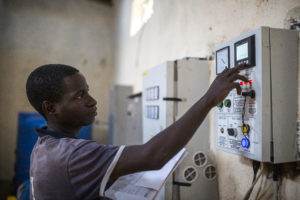
In Malawi, Steve maintains the micro-hydro power plant that uses the power of the river Bondo to provide electricity to local homes, businesses, clinics and schools.
Not far enough: Why the ‘normal’ approach is failing to connect so many
The traditional approach to providing electricity access is to extend the electricity grid linked to large (often fossil-fuel powered) power stations. However, building electricity grids is expensive and rural areas, especially the poorest and most remote ones (‘the last mile’), are often left behind by cash-strapped governments and utilities.
Luckily, there are alternative ways of providing access through off-grid renewable energy solutions. Practical Action was a pioneer in developing some of these, for example through community micro-hydro schemes in Kenya, Nepal, Peru, Zimbabwe and Malawi. Hydro isn’t possible everywhere, but wind and biogas are other options. In recent years, cost reductions have made off-grid solar photovoltaics (PV) particularly attractive.
Under current and planned policies (even before the start of the coronavirus crisis) it’s estimated that in 2030, 620 million people will still not have electricity access, 85% of them in sub-Saharan Africa. For many communities in remote locations, this means another generation or more of being left behind.