Small-scale solutions can lead to big change. This core principle was central to the philosophy of our founder, radical economist E.F. Schumacher. Our work developing and promoting a farming technique called Pfumvudza in Zimbabwe shows it’s as relevant today as ever. After working with smallholder farmers to use this innovative technique, we’ve passed the baton to the Government of Zimbabwe, who are rolling it out across the country.
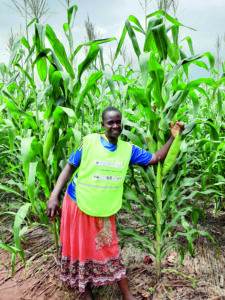
A field of nutritious maize means a boost to Shuwiso’s health and income.
The challenge
More of the world’s people rely on agriculture for their survival than any other occupation. But three quarters of the world’s poorest people are farmers, confirming that agriculture simply isn’t working for the most of them. Zimbabwe’s agricultural sector is predominantly smallholders, who are reliant on rain-fed crops. Climate change is altering the weather patterns, and they are becoming less predictable and more extreme. Low rainfall, drought and cyclones have led to extreme hardship. The impact on many smallholder’s livelihoods, food and nutrition is devastating.
Our goal
Our aim is to work with rural communities to build farming systems that connect nature (climate, land, water, plants and animals) with people (culture, economics and society). Sometimes referred to as ‘agroecology’, this approach can enable smallholder farmers to achieve a decent standard of living, whilst protecting the environment and building natural resources. The result is a sustainable alternative to intensive agriculture, with the potential to transform the lives of millions of families.
What we achieved in 2020/21
One of the solutions we’ve been supporting farmers to put into action is Pfumvudza. This innovative idea was originally developed by a local NGO and involves planting in small pot holes that trap water. Any remaining land is freed up to grow cash crops to earn an income.
After the government of Zimbabwe’s Secretary for Agriculture visited our programme, the government decided to scale the approach. This means it will reach a further 1.8 million farmers. Even more farmers will be reached with the inclusion of the approach in the government’s overall agricultural policy. The subsequent increased food production has the potential to reach 5m people – about 1/3 of the population of Zimbabwe.
Farmers using Pfumvudza saw a 700% increase in average yields when compared to conventional farming.