The adaptation finance mirage: climate promises are rising, but the money is not

By Byron Zamasiya, PhD
27 November 2026
Location: Africa
Issue: COP

By Byron Zamasiya, PhD

Climate Resilience & Disaster Risk Reduction Lead for Practical Action Africa


John is a farmer and father of three in Homa Bay, Kenya. Like many rural households across the region, he faces growing uncertainty. Having endured his third consecutive failed rainy season, he is preparing to plant a new drought-tolerant maize variety, hoping it will withstand increasingly erratic weather conditions. If this crop fails, he may be forced to shift to less profitable crops or seek alternative sources of income to support his family. John’s experience is far from unique. Across Kenya and much of Africa, millions of smallholder farmers who depend on rain-fed agriculture for their food, nutrition, and livelihoods are confronting similar challenges. As climate change intensifies the frequency and severity of droughts and other weather extremes, farming households are being pushed to the limits of their resilience, with significant implications for food security, rural incomes, and sustainable development.

For John and millions of other smallholder farmers in Africa, the distinction between adaptation pledges and adaptation finance is not academic. Access to funding has helped him try these drought-tolerant seeds in time for the new planting season and become part of a wider information network providing early warnings of floods, extreme heat and droughts – vital information for farmers working on the edge.

The international community has become remarkably good at recognising climate vulnerability. Governments routinely negotiate adaptation commitments, endorse resilience frameworks, launch financing roadmaps and reaffirm solidarity with climate-vulnerable countries. What remains far more difficult is mobilising the finance needed to turn those commitments into tangible resilience on the ground.

This contradiction was on full display at COP31 in Antalya. While governments continued to acknowledge the urgency of strengthening adaptation in developing countries, support announced for one of the world’s most important adaptation financing mechanisms fell sharply.
Africa is already paying the price

For Africa, adaptation finance is not an abstract negotiating issue. It affects whether farmers can cope with erratic rainfall and prolonged droughts. It determines whether communities have reliable access to water, whether infrastructure can withstand increasingly severe climate shocks, and whether governments can invest in resilience rather than repeatedly diverting scarce resources towards disaster response and reconstruction.

Climate change is amplifying existing development challenges across the continent, including poverty, ecosystem degradation, infrastructure deficits and limited adaptive capacity. The resulting costs are increasingly borne by households, local authorities and small businesses whose livelihoods depend on climate-sensitive sectors.

The problem is not that African countries have failed to prepare. As of August 2025, Africa accounted for 65 of the Adaptation Fund’s 199 projects, representing approximately US$501.5 million in approved financing. Across the continent, countries have invested in adaptation planning, strengthened institutions and developed increasingly sophisticated project pipelines. The challenge is no longer whether many developing countries can absorb adaptation finance. The challenge is whether the finance arrives.

The global adaptation finance gap continues to widen

The Adaptation Fund’s financial situation should be understood against a much larger backdrop. According to estimates cited in the COP31 negotiations and drawn from UNEP’s Adaptation Gap Report 2026, developing-country adaptation finance needs are estimated at approximately US$305 billion annually through to 2035.

Against that backdrop, annual pledge announcements measured in tens or even hundreds of millions of dollars reveal the scale of the mismatch between need and delivery. The Adaptation Fund’s reported project pipeline of nearly US$2.4 billion points to substantial unmet demand. This pipeline includes project proposals and concepts at different stages of development and consideration, including those that have not yet received full approval from the Fund’s Board.

Developing countries continue to be encouraged to prepare National Adaptation Plans, strengthen investment readiness and develop bankable projects. Yet access to finance remains one of the biggest obstacles to implementation. This creates an increasingly familiar contradiction in climate policy: readiness without financing. No adaptation plan, however sophisticated, can protect livelihoods, strengthen water security, restore degraded ecosystems or establish effective early warning systems without resources for implementation.

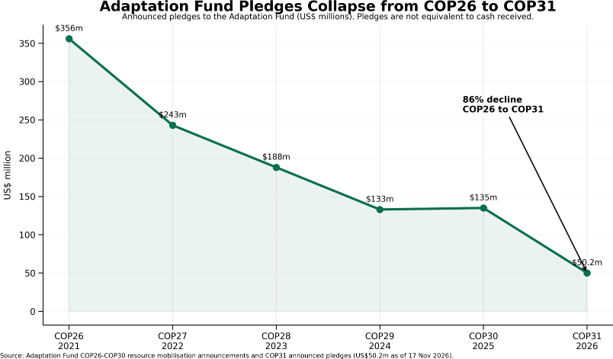
The Adaptation Fund received announced pledges of US$356 million at COP26 in Glasgow. However, this support has declined significantly over successive climate summits: approximately US$243 million at COP27, US$188 million at COP28,  US$133 million at COP29 and US$135 million at COP30. At COP31 in Antalya, announced pledges fell to just US$50.2 million.

These figures represent announced pledges, not necessarily money received by the Fund or finance already reaching adaptation projects. Nevertheless, the downward trend raises serious questions about the consistency and reliability of international support for climate adaptation.

While the Adaptation Fund is not a measure of all global adaptation finance, it provides an important indication of the support being mobilised through one of the principal multilateral funds dedicated to helping vulnerable countries adapt to climate change.

A warning signal from the Adaptation Fund

The decline in Adaptation Fund pledges points to a challenge that extends well beyond a single institution. At COP31, six contributors -Spain, Germany, Ireland, Portugal, Estonia and the Brussels Region of Belgium announced pledges to the Fund. Spain and Germany accounted for approximately three-quarters of the US$50.2 million announced. This highlights a wider weakness in the international adaptation finance system: the Fund remains heavily dependent on a small group of contributors and their domestic political and financial priorities.

The US$50.2 million announced at COP31 represents roughly one-sixth of the Fund’s annual mobilisation floor of US$300 million. It is also only around 4% of its minimum resource mobilisation target of US$1.2 billion for 2026-2029. These figures underline the scale of the shortfall and the uncertainty surrounding the resources available to support climate-vulnerable countries.

Whether future contributions will close this gap remains uncertain. What is clear, however, is that adaptation ambition is increasing faster than adaptation finance. This growing disconnect matters because adaptation is no longer a future challenge. Across much of the developing world, it is already a development challenge, a fiscal challenge and an increasingly urgent human security challenge.

COP31 preserved ambition but failed to provide certainty

The negotiations in Antalya reflected the same contradiction. An earlier Presidency proposal reportedly included a quantified ambition of at least US$120 billion annually for adaptation finance by 2035. That figure was later removed from subsequent drafts and should not be interpreted as an agreed COP31 target. Yet it would also be wrong to conclude that adaptation ambition disappeared from the negotiations.

The 22 November Presidency draft reaffirmed efforts to at least triple adaptation finance by 2035. It also proposed the Antalya-Addis Ababa Roadmap and outlined a process through which governments could establish a baseline for measuring progress. However, these were proposals in the Presidency’s draft, not agreed COP31 decisions. Those provisions matter. But a roadmap is not a financing plan.

The draft did not establish an agreed annual adaptation finance target. It did not allocate responsibility among contributing countries. Nor did it guarantee that additional resources would reach developing countries in the years ahead.

Most significantly, COP31 concluded without consensus on the overarching political package. For climate-vulnerable countries, the outcome reinforces a familiar pattern. Adaptation needs are increasingly recognised. Agreement on how to finance them remains far more elusive.

Why delaying adaptation makes no economic sense

The failure to adequately finance adaptation should also be recognised for what it is: a growing economic risk. Delaying adaptation investments does not eliminate future costs. It simply shifts them into disaster response, humanitarian assistance, infrastructure reconstruction and lost development opportunities. Investments in climate-resilient agriculture, ecosystem restoration, water security, resilient infrastructure and early warning systems can substantially reduce future losses and help protect decades of development gains.

Investing in climate resilience also makes economic sense. Every US$1 invested in climate adaptation can generate more than $10 in benefits over a 10-year period, including avoided losses, economic gains and wider social and environmental benefits. While returns vary across interventions and contexts, the broader economic case for investing in resilience is compelling. The economics are increasingly clear. The politics of financing adaptation remain the problem.

What must change before COP32?

If confidence in international climate cooperation is to be restored, governments must move beyond broad commitments and ensure that adaptation finance reaches the communities that need it.

First, governments must set out a clear and measurable plan for increasing adaptation finance. This means agreeing how much funding will be provided, setting milestones and reporting regularly on progress. Commitments to triple adaptation finance by 2035 must translate into resources that countries and communities can actually access.

Second, funding must be more predictable. Climate adaptation cannot depend on governments making new financial promises at every international summit. Longer-term funding commitments would help organisations and local institutions plan ahead and invest in solutions such as climate-resilient agriculture, water security and early warning systems.

Third, finance must reach the people and organisations closest to the challenges. Local organisations and communities need better access to funding so they can develop and deliver solutions that respond to their circumstances. This could mean supporting farmers to adopt drought-tolerant crops, helping communities strengthen their water supplies or improving access to early warnings before floods and extreme weather.

Finally, governments and funding institutions must be more transparent about where the money goes. It is not enough to announce pledges. They must report how much funding has actually been received, how much has reached projects and what difference it is making to people’s lives. Practical Action’s experience demonstrates that effective climate adaptation must go beyond planning to deliver practical, community-led solutions that turn funding into tangible benefits for those most impacted by climate change.

The real test of climate solidarity

The debate around adaptation finance is no longer about recognition. Governments recognise the risks. The science is clear. The impacts are visible across every region of the world.

Nor is the debate fundamentally about economics. The evidence increasingly shows that investing in resilience is far cheaper than repeatedly paying for climate-related disasters. The real question is political. The world does not suffer from a shortage of adaptation plans, declarations or commitments. It suffers from a shortage of delivery.

If adaptation finance continues to lag behind adaptation needs, the consequences will not be felt in conference halls or negotiating rooms. They will be felt in farms that can no longer sustain livelihoods, in cities struggling with escalating climate shocks, and in communities forced to absorb losses that could have been reduced through timely investment. The question facing governments is no longer whether adaptation deserves greater political recognition. That case has already been won. The question is whether they are prepared to finance resilience at the scale the crisis demands.

For a farmer in Homa Bay, Kenya, the value of a successful COP32 will not be measured by the number of commitments announced. It will be measured by whether those commitments translate into practical support: access to drought-tolerant crops, reliable weather information and early warnings that help protect harvests and livelihoods. This is where organisations such as Practical Action play an important role, working with communities to turn adaptation approaches into practical solutions on the ground.

By the time delegates leave Addis Ababa at COP32, the measure of success should not be how many new commitments have been announced, but whether vulnerable countries and communities can point to finance that is real, accessible and reaching the people who need it. Anything less will reinforce a reality that climate-vulnerable nations know too well: adaptation ambition is rising, but adaptation finance is not.