Clean energy for Nepal

Nepal’s manufacturing industry is essential to the country’s economic future. But it faces a major challenge: even though the country has huge hydropower potential, frequent power cuts mean factories must often fall back on expensive, polluting diesel generators. This drives up emissions, harms air quality, and puts climate goals at risk.

The Grid Resilience through Intelligent Photovoltaic and Storage, Phase 2 (GRIPS2) project is tackling this challenge by building Nepal’s largest smart solar and battery storage system, based at Laxmi Steel Factory in Butwal. This new microgrid will replace diesel backup with reliable, AI-supported clean energy – cutting pollution, reducing costs, and setting the stage for wider industrial decarbonisation.

An orange calendar icon with a black outline featuring a square marking a day.
Dates

2025-2028

A globe with a circle.
Country

Nepal

A lightning bolt on a grey background, representing the practical action we take.
Themes

Energy that transforms

Building a just and sustainable energy future

Sunwal, an industrial hub in southern Nepal, hosts more than 100 factories. It highlights both the promise and the problems of the sector: strong growth and job opportunities on one hand, but energy insecurity, rising emissions, and unequal access to opportunities on the other.

Despite Nepal’s dependence on hydropower, the electricity grid is unreliable. As a result, factories turn to diesel generators that release tonnes of CO₂ and pollute the air. At the same time, many groups – especially women and marginalised communities – struggle to gain fair access to industrial and technical job opportunities. GRIPS2, led by Practical Action in partnership with Gham Power and Swanbarton, and with support of UNIDO’s Accelerate-to-Demonstrate (A2D) Facility, takes a systems-change approach. It integrates clean energy innovation with gender equality and social inclusion (GESI) and environmental and social safeguards (ESS), ensuring that the energy transition benefits everyone – from factory workers to local communities. This initiative will allow the creation of more environmentally sustainable jobs, while empowering workers through training and capacity-building.

Through Nepal’s first large-scale, AI-driven microgrid, GRIPS2 will prove that clean, affordable, and reliable energy for industry is not only possible, but a major step for sustainable development, public health, and climate action in South Asia.

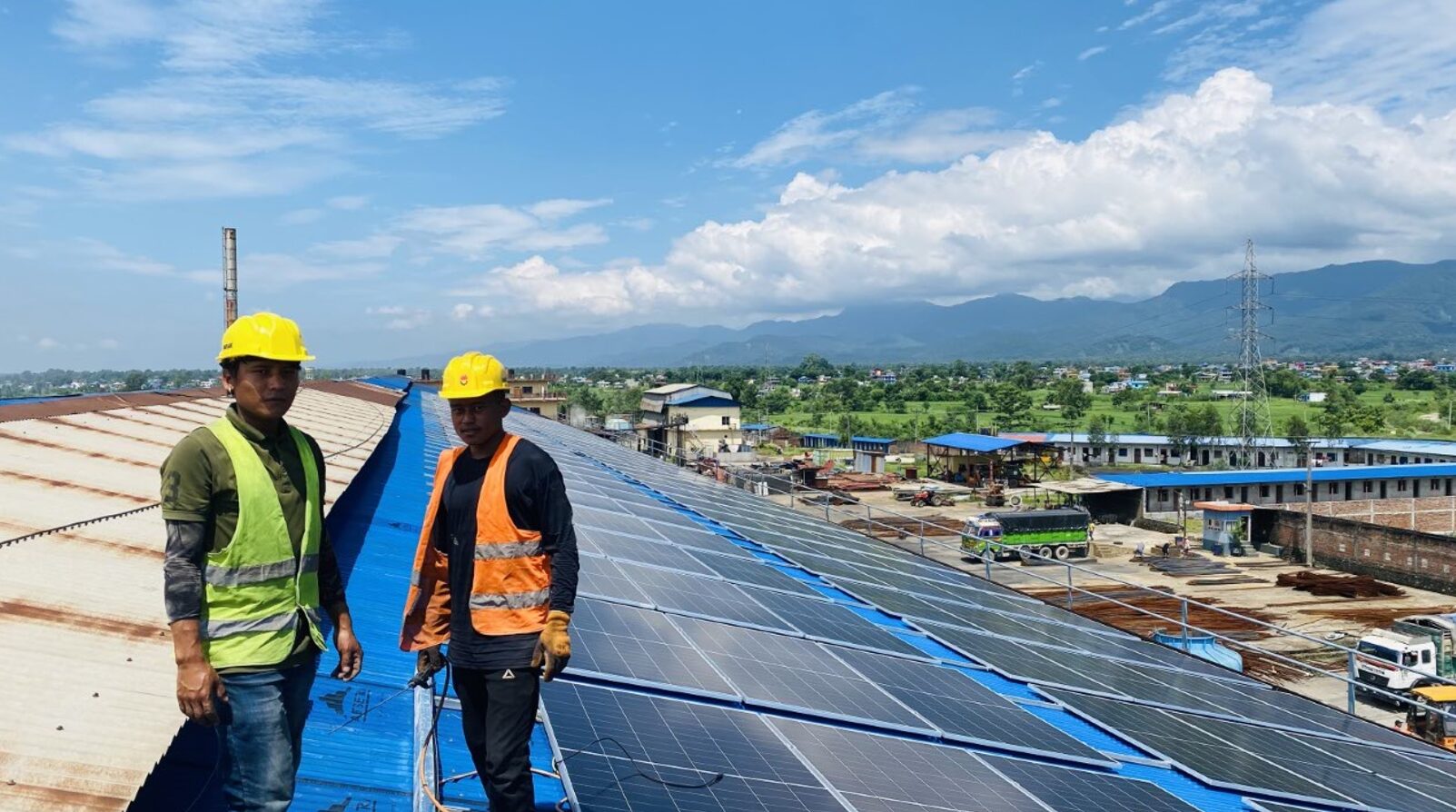
Two workers in safety gear stand on a rooftop with solar panels, overlooking an industrial area with mountains and clouds in the background.

Project Overview

Title: Grid Resilience through Intelligent Photovoltaic and Storage, Phase 2

Dates: February 2025 – March 2028

Location: Nepal

Our role: As the lead organisation, Practical Action is implementing Nepal’s largest smart battery energy storage microgrid. Combining innovative clean energy technology and a people-centered approach, we aim to create a model that’s scalable nationally and regionally.

Participants: Laxmi Steel Factory in Sunwal, its employees, and its surrounding communities.

Project budget: USD $2.99 million

Theme: Energy that transforms

Partners: Gham Power Pvt. Ltd. (Nepal) and Swanbarton Ltd. (UK)

Lead donor: The United Nations Industrial Development Organization (UNIDO)’s UK Government-funded Accelerate-to-Demonstrate (A2D) Facility.


Our approach

A new model for clean industry

At the heart of GRIPS2 is a transformative solar-plus-storage system, comprising a 2 MW / 4 MWh battery with a 924 kWp solar array from Gham Power, and an AI-powered microgrid management system from Swanbarton,

Together, these systems will:

  • Remove the need for diesel generators as backup power.
  • Provide uninterrupted, clean electricity during power cuts.
  • Reduce operational costs and emissions.
  • Improve air quality in and around the factory.

But GRIPS2 is more than just a technical upgrade. It’s a people-centred project that:

  • Trains Nepal’s clean energy workforce and improves health and safety for over 500 factory employees
  • Champions gender equity and inclusive employment
  • And offers a scalable, replicable model for clean industrial energy across South Asia

Our Goals

By the end of the project, we will:

  • Eliminate the need to use diesel generators at Laxmi Steel Factory, offsetting 2,800 tonnes of CO₂ over 25 years.
  • Save the factory over USD $1.3 million in electricity and diesel costs, making it an appealing example for other businesses to follow.
  • Train and upskill Nepal’s engineers and solar technicians in smart microgrid technologies.
  • Create safer, healthier working conditions for 500+ factory staff members.
  • Establish a steering committee to monitor gender equality and social inclusion (GESI) and environmental and social safeguards (ESS), with regular KPI reviews.
  • Launch a GESI action plan to assess workforce patterns and promote equitable employment.
  • Implement an ESS action plan supporting corporate social responsibility initiatives in biodiversity, waste management, and community engagement.
  • Demonstrate a replicable model for over 100 similar businesses across Nepal and South Asia.

A scalable, replicable model for South Asia

Our work is designed with scale in mind. By proving that clean energy systems can power industry reliably and affordably – even in environments with unstable energy grids – it offers a template for replication in more than 100 factories across Nepal, with further potential in other countries in South Asia.

Through this project, we aim to further a just, inclusive transition to a future where clean energy transforms lives.

Work like this depends on your support

Help us work with communities to tackle some of the world’s toughest problems.

Donate securely