I’m creating opportunities and looking forward to growing my business.
Elizabeth Angeo
Elizabeth Angeo’s farming journey
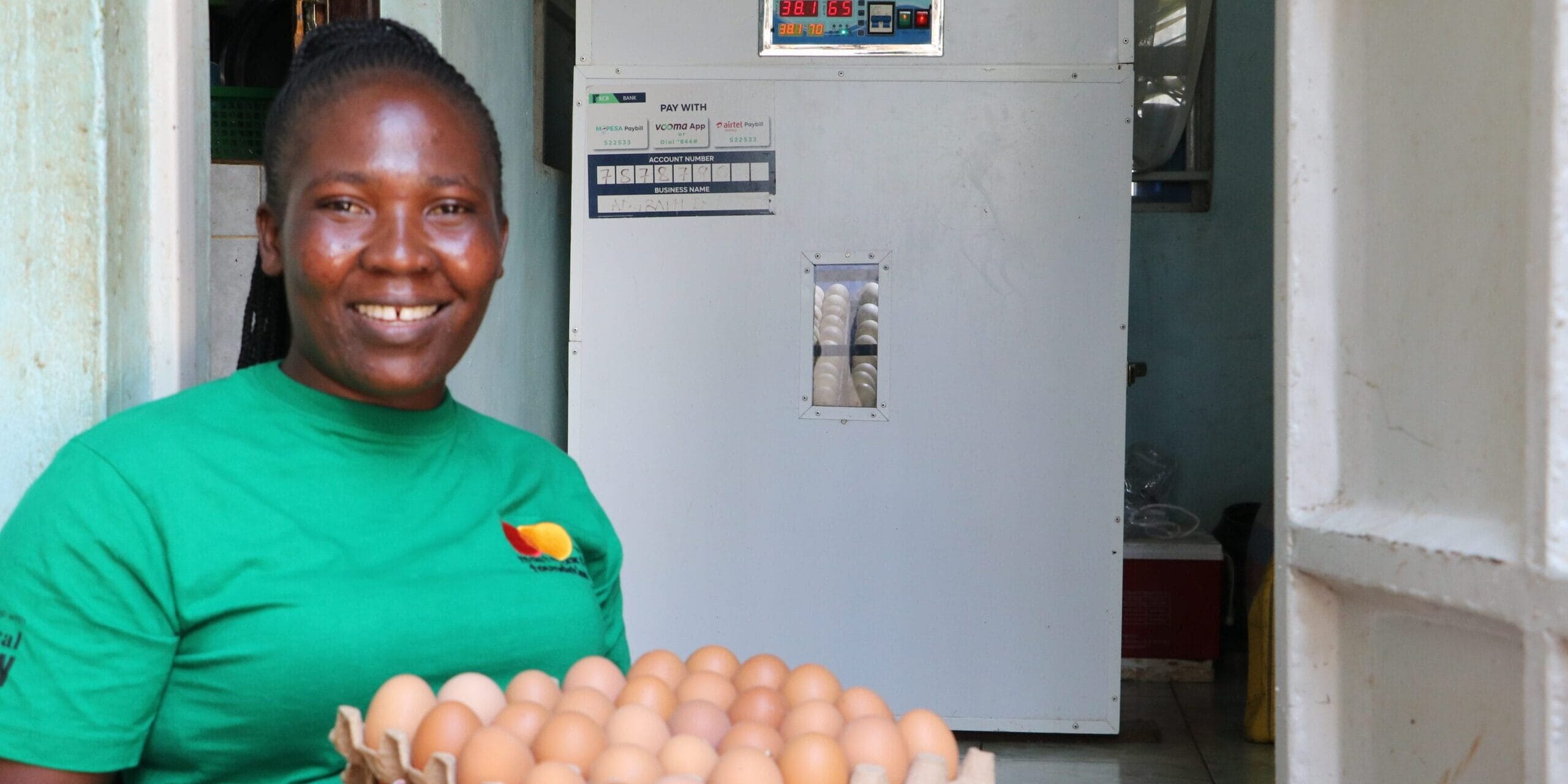
At sunrise in Vihiga County in western Kenya, Elizabeth Angeo checks the temperature inside her solar-powered incubator before the day begins.
Inside, rows of eggs are warming. In a few days many will hatch into chicks, which she sells to other farmers. Some she raises to maturity before selling. Outside, neat beds of vegetables grow on her farm. She supplies them to nearby schools, hotels and local traders. She also sells table eggs and runs a small egg depot just outside her home, where customers collect their orders.
It did not start this way.
When Elizabeth graduated from university in 2017, she returned home with a degree but no job. A year of job applications brought silence. Interviews led nowhere. With a young family to support, she turned in 2018 to a small piece of family land.
She began by growing collard greens and rearing poultry. Her income was unpredictable, and buyers often delayed payments. When she leased extra land to expand, she invested in seeds and labour, only to be asked to leave before the lease ended. Finding capital to grow her business was difficult. In her community, young women like her were rarely taken seriously.
Still, she kept going. “I was working hard,” she says, “but everything felt uncertain.”
I’m creating opportunities and looking forward to growing my business.
Elizabeth Angeo
In 2023, she joined the Practical Action and Mastercard Foundation ‘Resilient Agriculture for Young People’ (RAY) programme, working with partners and young farmers to facilitate agriculture-related businesses led by young people, especially women. Learning alongside others, she improved how she farmed. She began using compost and mulch to protect and enrich her soil. This helped her crops withstand dry spells and reduced spending on chemical fertiliser.
She also trained in poultry management, vaccination and affordable feeding. She learned to grow azolla, a protein-rich water plant, and to rear Black Soldier Flies, both of which produce low-cost poultry feed. These changes lowered her costs and improved her margins.
Through discussions with other young farmers, she saw another opportunity. Many struggled to find quality chicks locally. She decided to fill that gap.
Practical Action connected her to a financial institution willing to lend at an affordable rate. With a clear business plan, she secured a £2,300 (KSh 400,000) loan and invested in solar-powered incubators.
Today, she hatches and broods around 300 chicks each week. She also sells table eggs and supplies vegetables to schools, hotels and women retailers. Demand is steady.
She employs four full-time workers and hires others when needed. “I am no longer looking for employment,” she says. “I’m creating opportunities and looking forward to growing my business.”
The change is not only financial. At home, she now shares decisions about spending and investment. In her community, she is known as a business owner and mentor. She supports twelve young farmers, eight of them women and one a person with a disability. Some of her mentees are now mentoring others. “I cannot walk the journey alone,” she says. “We uplift each other.”
Her story reflects wider change across western Kenya. More than 80,000 young people are growing farming businesses via the impact of the RAY project. Nearly two thirds are women.
A recent independent review found that women’s average incomes more than doubled through work facilitated by Practical Action. Many have joined savings groups, helping them manage money, plan ahead and invest in their farms. More women now take part in decisions about household spending, showing greater confidence and respect at home. Most are also using farming methods that improve soil, lower costs and help them cope better with drought and changing weather.
There are early signs of deeper shifts. Some local lenders are more open to financing young women. Buyers are forming more regular supply arrangements. Savings groups continue beyond initial training. Young women once seen mainly as helpers are increasingly recognised as entrepreneurs.
Challenges remain. Many still farm land they do not own. Larger loans are hard to access. Social attitudes change slowly. Climate change also means droughts are more frequent.
Practical Action’s aim is to strengthen local systems so progress continues beyond any single programme. By 2027, the goal is to work with 100,000 young people in western Kenya, including 70,000 women and 5,000 people with disabilities.
Across the region, young women are building businesses despite unemployment, limited land rights and restricted access to capital. With practical skills, they are earning respect and shaping a more secure future for themselves, their families and communities.
Help us work with communities to tackle some of the world’s toughest problems.
The transformation has had a powerful impact on Martha’s livelihood. She now earns more, spends less, and feels confident about the stability of her farm.
“Now I rear 500 chickens and I can sell 300 a month,” Martha says with pride.
“I no longer spend money on chemicals, and I am also making more money from my crops.”
Her journey shows how practical, regenerative solutions can help farmers build a future that is not only productive – but sustainable, resilient, and full of possibility.