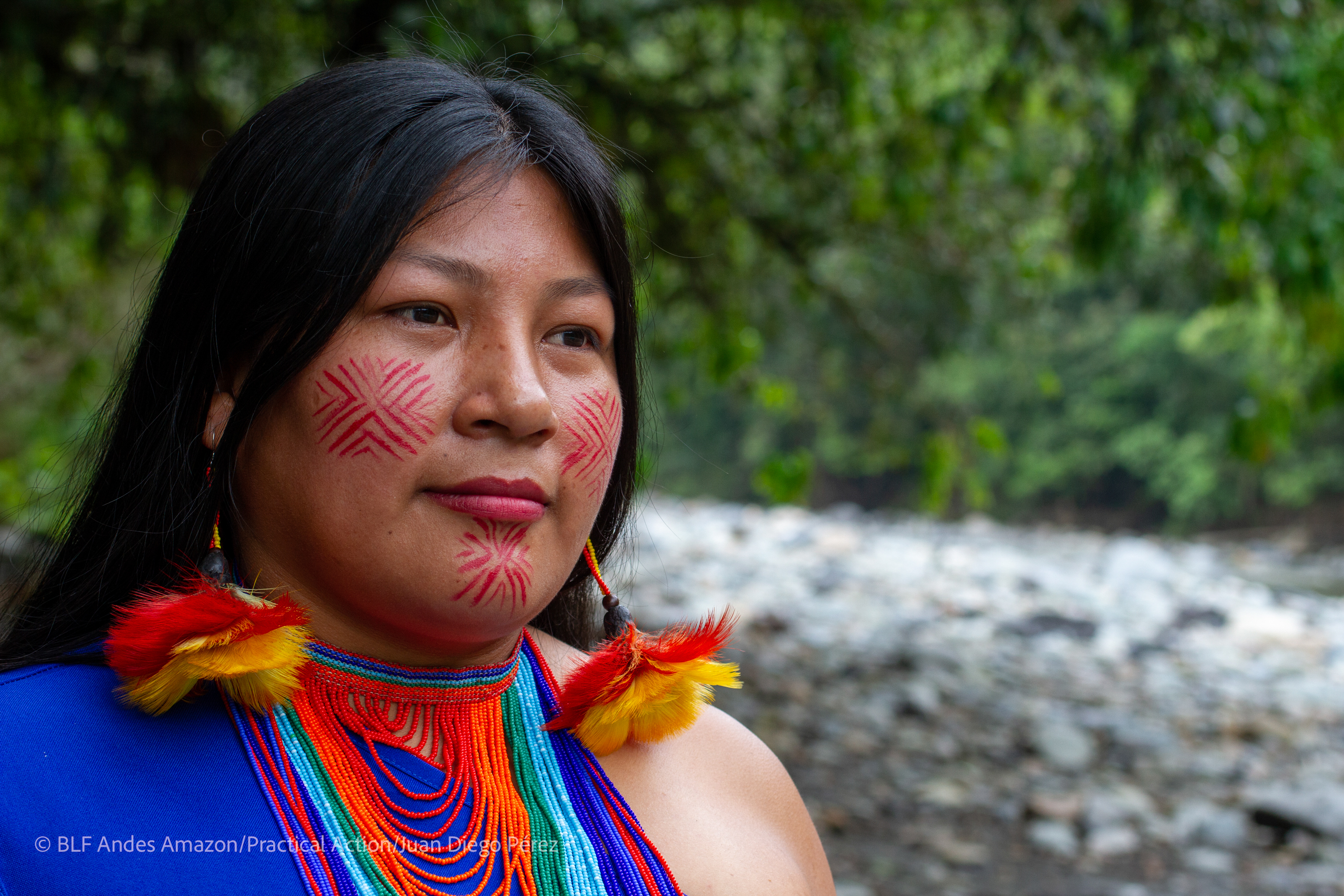
Women from the provinces of Morona Santiago and Zamora Chinchipe in Ecuador, and from the provinces of Bagua, Condorcanqui, and Datem del Marañón in Peru, are not giving up. They are part of one of the most vulnerable populations on the planet; however, they are working slowly but surely and unstoppably to become part of the spaces from which they have always been excluded, but which they should always have been part of.
These are the Awajún, Wampís, Kichwa, Shuar, Achuar, Chapra, Kandozi, and Shawi women, among others, who live in the cross-border area of high animal and plant diversity located between Ecuador (provinces of Zamora Chinchipe and Morona Santiago) and Peru (provinces of Condorcanqui, Datém del Marañón, Bagua, Jaén, and San Ignacio). Represented by the testimonies of eight women leaders belonging to different indigenous organizations in the area, they have created “Weaving the Future. Progress and challenges of indigenous Amazonian women in Peru and Ecuador,” a publication of the Interethnic Association for the
Development of the Peruvian Rainforest (AIDESEP) and the Confederation of Indigenous Nationalities of the Ecuadorian Amazon (CONFENIAE), with the support of Practical Action through the BLF Andes Amazon project, which presents stories of struggle, creativity, and concrete proposals to conserve and promote the development of their communities.
The publication highlights the transformative power of indigenous women in the Peruvian and Ecuadorian Amazon, protagonists of a silent revolution that sustains daily life, protects ancestral knowledge, and contributes to the conservation of the territories that are essential to their peoples and nationalities. Their contributions, which have always been present, are amplified today with new opportunities to strengthen their leadership and participation in education, health, and economic and political spheres, advancing with determination in the face of the challenges that still persist in this cross-border territory with more than 8 million hectares of forests, which is one of the most biodiverse in the world.
Thus, from Ecuador, Sandra Alvarado, Women’s Leader of the Confederation of Indigenous Nationalities of the Ecuadorian Amazon (CONFENIAE); Magaly Nawech, Representative of Women of the Shuar Arutam People (PSHA); Lorena Tando, Women’s Leader of the Provincial Federation of the Shuar Nationality of Zamora Chinchipe (FEPNASH ZCH), and Shiram Jindiachi, Women’s Leader of the Shuar Nationality of Ecuador (NASHE); and from Peru, Teresita Antazú, First Member of the National Executive Council of the Interethnic Association for the Development of the Peruvian Rainforest (AIDESEP) and head of its Indigenous Women’s Program; Matut Impi, Vice President of the Awajún Autonomous Territorial Government (GTAA), Raquel Caicat, Vice President of the Regional Organization of Indigenous Peoples of the Northern Amazon of Peru (ORPIAN-P) and head of its Indigenous Women’s Program; and Elain Shajian, president of the Regional Coordination of Indigenous Peoples of San Lorenzo (CORPI-SL), give shape, through their testimonies, to an essential publication for understanding the increasingly important role of indigenous women in decision-making that affects the present and future of the peoples they represent.
Through their life stories, they present the structural barriers they have encountered along the way, both in society and within their own organizations, where institutional commitment to gender equality is still weak and machismo continues to restrict their full and effective participation. They show us how, despite all these limitations, their determination to organize, educate themselves, and advance their political and economic autonomy is beginning to materialize in concrete proposals, such as women’s congresses, internal ordinances, and more active participation in regulatory processes and leadership roles.
Their stories tell us of experiences and ways of understanding the world that already outline powerful paths of transformation, but which still need more support from society, the state, cooperation, and the organizations to which they belong. And they remind us of the enormous capacity of Amazonian women to sustain and defend organizational, cultural, and territorial processes.

BLF Andes Amazon
The BLF Andes Amazon Project seeks to join forces and contribute to the conservation of biodiversity, connectivity, and territories of life; the strengthening of indigenous organizations; and the improvement of livelihoods for more than 7,500 families. It is funded by UK International Development through the Biodiverse Landscapes Fund and implemented by a consortium led by Practical Action and comprising Nature and Culture International, AIDESEP, WWF, TERRA NUOVA, and COSPE.