Participatory Market Systems Development (PMSD)
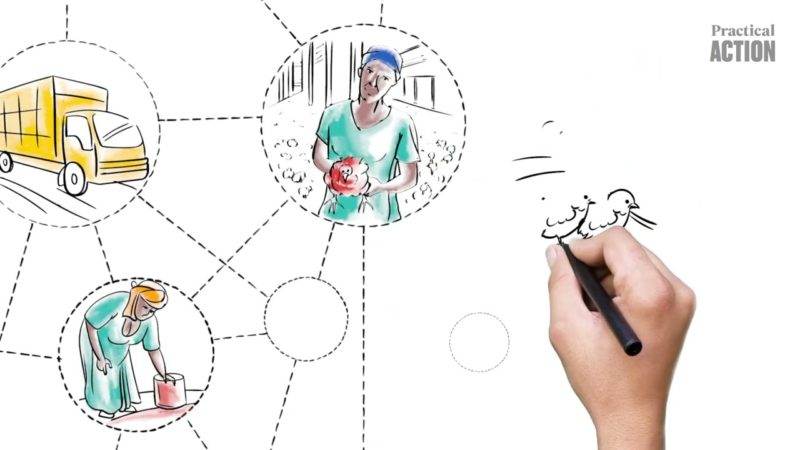
However, markets can be plagued with inefficiency and inequality between different groups of people, especially in contexts where poverty is acute. This can be caused by a number of things, for example a lack of access to critical information like the current price of crops, misunderstandings and conflicts between buyers and transporters, inefficient policies or just poor infrastructure.
Practical Action has been developing an approach called Participatory Market System Development (PMSD) to make markets more inclusive, reduce poverty on a large scale and protect the environment.
PMSD is designed to bring all of the key people within a particular market together. These people are known as stakeholders, or market actors. The PMSD process works to build trust and a joint vision of change between these market actors, and helps them to collectively identify obstacles and opportunities affecting their market system. Facilitators trained in PMSD techniques support the group of market actors to come up with joint strategies and action plans that will overcome these obstacles, and take advantage of potential opportunities to improve market conditions for everyone. The approach, which has been developed over 12 years of fieldwork, is based on three broad principles: participation, systems thinking, and facilitation. You can read more about these principles further below.
Principles
PMSD is based on three core principles:
-
Systems thinking: Markets are complex systems that adapt to new information constantly. They are made up of large numbers of actors who are connected to one another and whose decisions are influenced by, and have an influence on each other. These “complex and adaptive” systems behave in ways that achieve more than the sum of their parts. In other words, we cannot predict how the system will behave by looking at the individual people or parts; we need to understand the relationships and the interactions.
-
Participation: Applying systems thinking to markets forces us to recognise that no single actor can determine how the system will change. Some very powerful actors can influence the trends or general direction of change, but how this change manifests in reality is a product of the decisions of all the actors. As a consequence, if we want to influence how a market system develops, we need to bring strategic players together to gain an understanding of the whole system, to jointly assess blockages and opportunities and to implement collaborative strategies and actions that will improve how the system functions.
- Facilitation: Facilitation can be understood here as creating the conditions for public and private market actors to drive change themselves. If we want to become effective facilitators, we have to therefore avoid becoming actively involved in the market as market actors. Facilitators can provide support, and even use subsidies as a way to build trust and joint visions, and to contribute to the introduction and dissemination of new ideas, practices or business models; however this must always be as part of an exit strategy. Good facilitation is at the heart of sustainability, because it is underpinned by the ownership that the key actors have over their own process of change.
Process
The above principles shape how we work on the ground. Whilst the reality of the process is messy, organic, and interactive, the following describes the typical sequence of steps that our field staff follow when carrying out PMSD.
The PMSD process starts with field staff analysing factors such as the potential to reach those most in need, and a particular market’s potential for growth, so that they can establish which markets within an area (for example, dairy or rice) provide the best opportunities for reducing poverty on a large scale. The next step is to get a better understanding of that market system, and the problems within it, by mapping out how the system fits together, and researching each connection and market actor in detail.
Facilitators then work to engage the key public and private actors within that market who can drive change – i.e. actually make the system work better – and find “hooks”, which are essentially just a set of convincing incentives that can motivate them to attend participatory workshops with all the actors within the market chain.
At the same time, the facilitators work to empower representatives of the marginalised actors so that they can engage with the rest of the actors in a meaningful way in these participatory workshops. By improving their business language and helping them to better understand the market, it puts them on a more capable and even footing to have an influence on how the process of change will take place.
Within the workshops, tools and activities are used to help the actors to visualise the market, and staff facilitate the market actors in understanding where the opportunities and blockages are within the market system. It is through these interactions that the market actors can develop a joint vision, to build trust, and to coordinate their actions and collaborate, to achieve positive changes within the market system.
As facilitators we support the actors throughout the process of strategic thinking, planning and action, in ways that help them to overcome potential conflict and risks. Throughout this time, we work to ensure that they steadily gain ownership of the process, so that once our intervention has come to an end, they can continue driving change in the future without us.
PMSD Roadmap
Since PMSD was created in 2002, we have been stressing the importance of understanding the principles, and giving field staff the freedom to apply them according to their needs. However we have realised that it’s important to provide practical guidance that will help practitioners to go through every step of the PMSD process, without losing their ability to be creative and responsive to the reality on the ground. This is why we have created a set of tools and guidance that practitioners can follow when they need to carry out PMSD. The steps are collectively known as the PMSD Roadmap, and they essentially describe the sequence above. The PMSD Roadmap is not a recipe that has to be followed step by step. Rather, it is intended to provide practitioners with the tools and inspiration to build the capacity of their staff and partners to become effective facilitators of PMSD.
Click here to read more about the PMSD Roadmap
Click here to view the steps
The PMSD Roadmap also includes materials for some of the most advanced facilitators to train their teams or partners on the ground.
See examples of the training materials here
PMSD Roadmap
To help its field teams to facilitate PMSD processes on the ground, Practical Action has been developing in-depth tools and resources that build skills and knowledge in these areas. These are collectively known as the PMSD Roadma...
Read moreA taxing situation for livestock farmers in Sudan
The 4.35 million nomadic pastoralists in Sudan produce livestock, much of which is exported to the Middle East. Yet they face innumerable challenges to gain access to inputs and advice, make effective links with buyers and become competitive and viable players.
Practical Action has been working in Kassala (Eastern Sudan), home to almost 200,000 pastoralists, since 2006. The process of participatory market mapping contributed significantly to the empowerment and awareness of semi-nomadic pastoralists. Specifically, it led to the identification of key systemic issues and priorities, such as the need for more and better animal health services, improved market coordination and a more favourable business environment. The latter concerned a taxation regime that directly affected the competitiveness and incomes of pastoralists. A livestock forum was created democratically by 35 market stakeholders as a result of the first market mapping workshop. It started with a broad agenda but the issue of taxation became a top priority. A tangible outcome of the market mapping process was that the Livestock Forum successfully lobbied the government to remove the double taxation that pastoralists faced when moving between the states of Kassala and Gedarif.
Since Practical Action left Kassala, the situation has improved further; Now, pastoralists are mobilising the livestock forum to solve other pressing problems, and in doing so are taking ownership and becoming stakeholders in driving the process of change within their market system.
This case study acts as an example of how PMSD principles manifest at different stages of the facilitation process. Empowerment of the pastoralists allowed them to engage more effectively with others, leading to the kinds of positive impacts described above. Allowing the stakeholders to identify priorities according to their own needs ensured that the greatest possibilities and opportunities were sought. And establishing interest forums such as the Livestock Forum ensures, as was demonstrated, that positive change continues after the project comes to an end.
If you are a practitioner, your feedback on PMSD is invaluable to us. What is your experience of using PMSD, and what comments or suggestions do you have? How useful have you found this information, and is there anything missing?
If you're a policymaker, tell us if there's any further information you need, or if you've used this information to design or implement policies.
If you're a supporter, then you can still help us by sharing this page with your Facebook friends and Twitter followers. It is your help that enables us to change lives for the long term, significantly for the better.
To contact us please email luis.osorio@practicalaction.org.uk
Practical Action Consulting offer bespoke PMSD training packages that can be tailored to the needs of your organisation. See thier training pages for more information.
Click here to read more about the PMSD Roadmap
View the PMSD Roadmap on Slideshare
PMSD: Best Practices in Implementation, A USAID Microlinks report