Smart phones, smart maps, smart apps…challenge Africa
This week’s Economist includes a Special Report on Telecoms in Emerging Markets. Some interesting trends are highlighted but care is needed when interpreting figures on teledensity. Nevertheless, mobile data networks may well produce a more cost effective impact on poverty than investment in other forms of broadband Internet access.
According to the ITU (International Telecommunications Union) mobile teledensity reached over 100% in 2007 (some people have more than one SIM and/or phone) in Western Europe. In Ghana the density reached 98% in January 2009 and is forecast to get to 100% in Kenya and Tanzania by 2013. But most of the traffic generated by this increased access will be voice – and voice is the most important means of communications for the poor who are more likely to have lower literacy levels. A major challenge remains: to upgrade the voice networks to allow fast data. Plans are in hand in most countries in Africa to improve the mobile data networks. But the reality is likely to be that fast connectivity such as 3G networks will be restricted to the urban areas. The costs of handsets is also an issue with a basic mobile phone down to around $15 but a smartphone costing over $100. Network provider charges for Internet access to use applications such as Google Maps are also likely to be high. In real terms probably many times higher than they are in the developed world.
Yet, amidst this context there are three encouraging signs for optimism:
- There is a growing “open source” sector of the mobile phone market. The Android operating system runs on mobile phones from various manufacturers. The source code is open so that applications developers can write programs that are tailor made for specific functions, languages, cultures, and geographies. These apps can then be downloaded free of charge by users.
- Some of the new applications are very relevant for use in developing countries. For example, epidemiologists and ecologists often collect data in the field and, on returning to their laboratory, enter their data into a database for further analysis. The recent introduction of mobile phones that utilise the open source Android operating system, and which include (among other features) both GPS and Google Maps, provide new opportunities for developing mobile phone applications, which in conjunction with web applications, allow two-way communication between field workers and their project databases. Source: Aanensen DM, Huntley DM, Feil EJ, al-Own F, Spratt BG, 2009 EpiCollect: Linking Smartphones to Web Applications for Epidemiology, Ecology and Community Data Collection. PLoS ONE 4(9): e6968. doi:10.1371/journal.pone.0006968
- Scientists are prepared to share their findings in open source journals such as the Public Library of Science (PLoS – see above). Thereby enabling scientists working in developing countries immediate access to good peer reviewed work.
The challenge is to upgrade the mobile phone networks to enable fast data traffic. Perhaps this is a candidate for applying advance market commitments that have been successful in the field of vaccines.
Smart phones, smart maps, and smart apps are all very well but they need to be enabled by smart markets.
1 Comment » | Add your commentWill one drip quench your thirst for knowledge?
Delivery of water is measured by the litre and the recommended daily intake (although contested by some) is that every person needs at least 2 litres per day to remain in good health. Should there be a recommended daily intake of knowledge? Whilst we might take for granted access to knowledge whenever we need it, billions of poor people do not have this luxury. Perhaps, like water, one drip at a time will not quench the thirst for knowledge. Some critical mass may be needed.
According to a story on the BBC News this week access to a mobile phone is more common than access to fresh water in Kenya. The BBC are running a series of stories this week about the impact of a fibre optic cable reaching the east coast of Kenya. It is clear from these reports that (comparatively speaking):
- the cost of accessing the Internet is high (Access Kenya have reduced charges from £2500 per month to £750 per month)
- the speed of accessing the Internet is slow (a domestic connection might reach 512Kb for £30 per month)
You may be wondering why, if people are short of drinking water they want access to the web? A good question. But the answer is not so simple. Pause to think that supplies of drinking water might be a necessary condition for getting out of poverty but not a sufficient condition. Access to knowledge that can effectively improve livelihoods will have an economic return. But such information needs to be delivered in a timely manner and at a speed that makes it effective in helping to change ways of doing things.
1 Comment » | Add your commentInternet in Africa – does it compute?
This week two quite different approaches to the problem of how to provide Internet access in developing countries (in particular Africa) caught my attention because each comes at the problem from a different standpoint.
First, a small organisation called hotmouse has launched a rugged terminal running Ubuntu. This device is positioned to be more robust than standard hardware for the dusty heat of Africa.
Second, Microsoft has launched OneApp – software that will run on a range of basic mobile phones to allow the user to access applications such as Facebook and offer the potential to run mobile banking services.
These initiatives are to be welcomed. Yet some fundemental questions need to be thought through. Will access to the Internet improve the livelihoods of poor people living in remote rural areas? Would alternative solutions, such as voice based knowledge sharing, be more in tune with local culture, literacy levels, and availability of electricity?
No Comments » | Add your commentLinking the mobile phone with a microscope for public benefit
The latest “add on” for a mobile phone is not likely to appeal to the market of young affluent professionals who like the latest gadgets. But in many much less affluent parts of the globe the mobile phone is reaching out as one of the technologies offering the potential to change lives. For social conversations, for business transactions, remittances, and mobile banking the mobile phone is fast becoming a tool that connects people who live in remote rural locations in developing countries.
The needs of those people go beyond those uses named above, into areas such as health and education. A paper published earlier this week in the open access journal PLoS ONE holds out the hope that via the combination of a microscope and mobile phone health services might reach into rural areas. More about this can be read on the BBC Technology News site.
The research team say that: “We expect such a telemedicine system for global healthcare via mobile phone – offering inexpensive brightfield and fluorescence microscopy integrated with automated image analysis – to provide an important tool for disease diagnosis and screening, particularly in the developing world and rural areas where laboratory facilities are scarce but mobile phone infrastructure is extensive.” (Breslauer et al 2009). This is a welcome opportunity for new technology to help poor people in rural areas but to enable the technology to be used effectively it should also be remembered that there will need to be capacity building for local communities. The supply of the technology is a start so long as we also work to engage the potential users to gain their buy-in and ownership. Now is the right time to do that and certainly it should not wait until the researchers have “perfected” the technology.
Reference:
1 Comment » | Add your commentCan “high-tec” offer simple solutions?
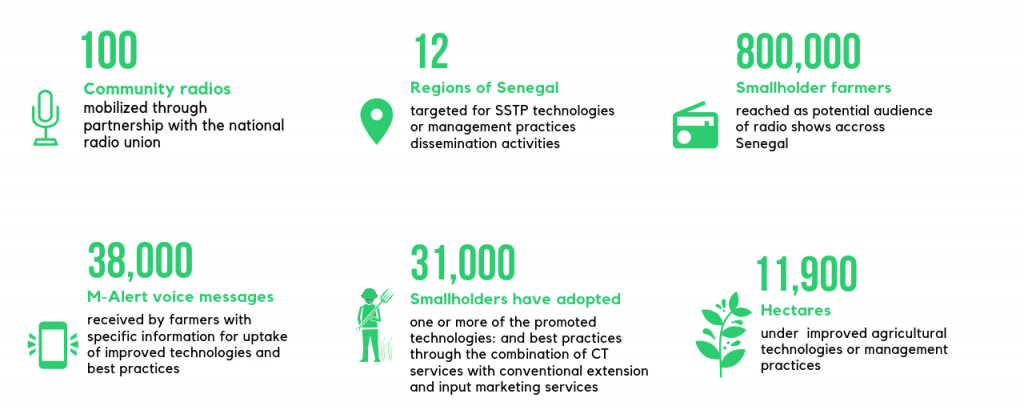
Today, The Times reports on page 54: “Simple Local Solutions to a Complex Global Issue”. Amongst other case studies the article picks out the work of Practical Action in Zimbabwe. Here we have reached 11,000 people with knowledge which is enhancing their livelihoods. These people live in an area that has no access to electricity, radio, or mobile phone. A “new technology” – an mp3 player – was introduced to enhance the existing ways of reaching people with new information and knowledge.
The technology is certainly “high-tec” but also it can rightly be argued that it is simple. Users have found it simple to use and the solution is relatively cheap.
This initiative is part of a theme of work that uses local content in local voices. Further background to this work can be found by following this link to another page on our website. We are currently working to spread this work to other countries to reach even more people in need.
No Comments » | Add your commentThe Digital Divide: we named it so now we must measure it
The International Telecommunications Union (ITU) has just published “Measuring the Information Society” (2009) an ICT Development Index covering the period from 2002 to 2007. At first sight the top level figures appear encouaging: over 4 billion cell phone subscibers, 1.3 billion land lines, and almost 1.5 billion using the Internet. But what progress has been made over the past 5 years? Do more people in the developing world need to use the Internet? The conclusion of the report is that “the magnitude of the digital divide is almost the same as five years before”.
The concept of the “digital divide” has acheived widespread currency over many years and is commonly interpreted as including both access to ICTs and use of the Internet. The ITU has then taken this broad definition and built a composite index to measure the divide. The index includes measures relating to mobile phone, fixed lines, and broadband Internet. For the first time the report now includes measures relating to an “ICT Price Basket” which relates tariffs for different services into one measure and then compares prices to relative income levels. For example this shows that in the UK broadband costs 0.8% of GNI whilst in Nepal this is 80% of GNI.
It is clear that those countries with relatively low costs of mobile phones have a high use level. With the direction of the technology heading towards the mobile Internet could it be that voice communications will be the major way in which developing countries increase access to and use of the Internet?
No Comments » | Add your commentTop 10 Emerging Technologies of 2009: Scores 2 out of 10
Each year the Technology Review, published by MIT, outlines 10 emerging technologies that will “change the way people live”. The current (March/April) issue list these technologies and reading it prompted me to ask “which people are going to be changed?” Almost all of these technologies are aimed at meeting the wants of people living in already rich countries.
Only two out of the 10 technologies have real potential to help developing countries.
- The first is a liquid battery which can allow solar power to be stored and then used at night. This would be wonderful in Nepal where there are currenly 20 hours each day without power and Kathmandu is dark each night.
- The second is a HashCashe which is a new method for storing frequently accessed Internet content that could make it cheaper for developing countries using the Net. The cost of Internet connections in the developing world is high (often in both relative and absolute terms). So there is a need to make effective use of bandwidth. HashCache slashes RAM and electricity requirements by roughly a factor of 10.
How long will it be before there is a higher “score” of emerging technologies of relevance to the developing world? Let us try to make technology relevant to the needs of people to live sustainable lives on the planet.
No Comments » | Add your commentNew institute to explore how world’s poor use technology to spend, store and save money
A new institute was officially launched on Thursday, 18 September 2008, funded (US$1.7m) by the Bill & Melinda Gates Foundation, to explore how the world’s poor use technology to spend, store, and save money. The Institute for Money, Technology and Financial Inclusion will be housed in the University of California at Irvine’s School of Social Sciences.
You might be wondering why so much money should be spent on academic study of a phenomena that has largely grown out of the innovation of people themselves in developing countries. But if you look at this intitiative from the point of view of collecting evidence and conducting rigorous research about the needs of poor people and how they adopt and adapt new technologies then it will be very worthwhile. It is also encouraging to read in the official press release that some money is to be spent in developing countries to support local research.
Reflect also on the issue that in the past research about how people use mobile banking might have been focussed on the main consumer markets in the world. Here it would be axiomatic that the research was connected with driving profit in high value markets. The context of the research of the new institute is clearly the world’s poor. Often, in the past technology has been driven by the needs of high value markets. Now, perhaps there is the opportunity to enable the technology to deliver on the needs of the poor. First there needs to be systematic research into their needs.
A final thought: it would be good to see this research effort engage with the multiple stakeholders that will be needed to translate the research into practice.
No Comments » | Add your commentData collection via mobile phone combats polio in Kenya
Collecting accurate, timely data from remote rural areas is a challenging problem. A BBC report claims that health authorities in Kenya have successfully done just this and furthermore, that there has been a significant health improvement. By monitoring patient symptoms and treatments, health workers claim to have stopped a polio epidemic. The system has won the prestigious Stockholm Challenge for Health. DataDyne.org, a not-for-profit consultantcy creating mobile information and communications technologies to serve public health and development, was also named a 2008 Tech Awards Laureate, one of 25 global innovators recognized each year for applying technology to benefit humanity and spark global change. The World Health Organisation has announced that it is taking this system to a further 20 countries in Africa.
So what is the technology behind this success story? EpiSurveyor is an open source software package that can be downloaded free of charge and changed by anyone to make it even better. It runs on a mobile phone or a PDA. Given that the mobile phone has spread to many poor communities in remote locations this becomes an existing platform from which to use the health application.
The story shows two things. First that using an existing technology platform provides a way of spreading new technologies; and second, that open source software allows for more rapid spread of technology that can be tailored to local circumstances.
No Comments » | Add your commentLeapfrogging connectivity for the other 3 billion
Today the BBC have a story that “Africans are to benefit from web plan“. It is now well known that there are many more mobile phones in Africa than there are landlines. This is often quoted as an example of “leapfrogging” over old technology straight into the latest new technology. So can this happen again with Internet access, which is generally very slow in developing countries?
A plan by o3b networks have a mission to make the Internet accessible to everyone on the planet – hence the name – the other 3 billion. Some well known businesses are supporting the venture, including HSBC and Google. At first sight then, this seems to be a force for good.
The venture should surely be welcomed as a sign that business is getting involved in the provision of solutions to poverty. But is it all positive news? There is an assumption behind this venture that information (of itself) is a good thing. But information is not neutral. People need knowledge or “know how” and this is much more complicated to provide than raw data or information. Sometimes information can effect the power balance in a community and that in turn can affect the culture and traditions.
I hope that o3b networks will work together with communities, NGOs and other stakeholders to enable meaningful knowledge and appropriate technologies to flow along their “pipelines”.
No Comments » | Add your comment