• Why I support Practical Action


    October 9th, 2012

    My name is James Bodin, I’m a third year Civil Engineering Student at the University of Portsmouth.

    I guess my whirlwind Practical Action adventure all began as far back as September 2011. It was at about this point where I met Jock from Student Adventures and Chris from Practical Action. During the information evening for London to Paris, Chris was so passionate about Practical Action I went home and read about the things they do and the people they help. It was at this point I knew I wanted to be part of that.

    Pretty much the next thing I can remember is being half way through a combined fundraising total of £3,250 for both the London to Paris and Kilimanjaro trips. I can now say: “Wow! That was definitely worth it!”

    I fundraised my money from all sorts of crazy methods, ranging from a 71p penny jar, all the way up to raising £500 for going bald with my sister making a video about it (YouTube – Bald Bodin).

    Other Fundraising highlights were: RAG Raids, Cake Sales, Buffets, Quizzes, Football Matches, Fifa Nights and SO much more! Including donations from all my family and friends, massive thanks to them all! (Especially the Anonymous “B” who donated £200!)

    The trips themselves were life changing and incredible! I met some great people and together we pushed through the pain barriers and managed to cycle 200miles in three days ending at the Eiffel Tower! Kilimanjaro was again amazing! I was fortunate to have an awesome group and together we all managed to summit the mountain, each overcoming our own troubles to conquer Africa’s biggest mountain!

    I can’t wait for next summer to be an adventure leader helping people experience what I have whilst also pushing them on to raise their thousands of pounds for Practical Action!


    No Comments » | Add your comment
  • Waging peace in Sudan on International Day of Peace

    It’s International Day of Peace today.

    But I want you to think about a place synonymous with war – not peace.

    Sudan.

    It’s one of those places to which you just don’t go – “hell on earth” as someone once said to me.

    Sudan has witnessed some of the most horrific acts committed by humankind.  Images of genocide and famine are beamed into televisions around the world, and this is what we think of when think of Sudan.

    Only last week, demonstrators in Khartoum protested fiercely and furiously outside the US, UK and German embassies in order to express their anger at an American You Tube film which allegedly mocks Islam. In August, a Sudanese police man was shot dead by an armed gang and various government buildings in Darfur were attacked.  Such violence serves to underline the dangers of operating in one of the world’s most volatile places.

    In June 2012, I spent two weeks there, primarily to visit Practical Action’s work in Darfur.

    On Saturday 23 June, the day of my 25th birthday, I met 9 year old Idris Abdullah. He was tending to his herd of goats as they drank from the water trough, and he was not holding a gun. He was one of the few children without one. The water point was engulfed by herds of thirsty goats and cows and camels, but I could not stop staring at the innocent children gripping guns.

    This is the reality of life in Darfur.

    Although the conflict, which was primarily an ethnic clash, ended in 2006, the official peace is fragile. Spikes of intense fighting between rebel groups, warring tribes and military forces continue to wreak havoc on the people who make their homes here. I met and spoke with so many women, children and men who must live under the ominous shadow of violence.

    One mother, Amel Mahmoud Osman, said to me We always have the fear that something will happen, but in order to survive we have no choice but to overcome it. We pray to God for safety.” And then she recalled watching pregnant women “bleed their babies away” during the heights of the terror of war.

     Another young woman, Sara Abubker Ahmed, remembered the day her friend was blown up by a government bomb:I still smell the blood. For months afterwards I couldn’t eat or drink anything, I felt so sick all the time. The smell of the blood.”

     The words of another young person, Yassir Oman Musa, will haunt me always. “It’s tragic, but everyone in Darfur has a story of loss to tell.”

    Yassir’s acceptance of the futility of war is, of course, understandable, but it filled me with a sort of righteous rage. Why should anyone – even if you live in Darfur – have to accept a world dominated by violence?

    Practical Action refuses to accept such a world. We have worked in Sudan, and in Darfur, for the last 25 years and continue to work there, employing a team of national staff to help vulnerable and marginalised communities to survive and thrive, against the odds. Working in partnership with local people, we endeavour to provide small-scale, sustainable and appropriate solutions to the daily problems caused by a rapidly changing climate and the chaos of war. We use simple techniques to help communities improve their own food security by planting community forests and improving access to and quality of water through harvesting rainwater.

    But as sustainable development work is nearly impossible in the face of conflict, we are also striving to achieve a lasting local peace between traditionally warring neighbours. We use a host of approaches including facilitating mediation meetings, raising awareness about land ownership and demarcation of boundaries, and even producing educational community theatre.

    Our efforts to build peace in these fragmented communities are innovative, unique, and most importantly, showing signs of success. Indeed, Yassir told me joyfully “for the first time ever we are hopeful of lasting peace.”

    We have a chance to change the story of Darfur for good, to enable Amel, Sara, Yassir and so many others like them to move from war and suffering to peace and prosperity. But the work cannot be completed without further support.

    By supporting Practical Action this International Day of Peace, you could give the people of Darfur a chance for a stable, peaceful and secure future, for the first time ever. Children like Idris Abdullah can look after their animals in peace, free of those weapons which are too adult, too ugly for their innocent hands.


    No Comments » | Add your comment
  • “Before I was a poor man, but now I am rich.”

    When I was in Sudan, I met a man called Mohamed Mohamed Musa. He was one of the people who had undertaken a seven hour bus journey to travel from Kassala to meet me at the Practical Action offices in Khartoum. I interviewed Mohamed at length, to learn about his life, and how he had worked with Practical Action.

    My conversation with Mohamed was a fascinating one, and I wrote about it at the time on my blog Sprouting seeds for success and happiness. I remember being struck by his height. I’m quite small, and Mohamed towered over me. But he was very thin, and his collar bones protruded sharply. I remember noticing his clothes – he wore a ‘jalabya’, a simple long white gown, and an ‘eimma’, a turban – but he was also very proud of his very cool Ray Ban style sunglasses. But mostly I remember Mohamed’s face. It was fascinating, magnificent, the sort that has a whole life etched into it.

    Today I received some really sad news from one my colleagues in Sudan.

    Mohamed has passed away.

    He died on 9 September after falling ill with a parasitic infection which is spread by contact with dirty water.

    I am filled with sorrow. Mohamed was 64 – a good age – but at no point in our conversation did he seem weak, or frail, or ready to leave his life. He was passionate about Practical Action, and spoke enthusiastically about his hope that one day he would be able to help other poor people in Sudan in the way that Practical Action had helped him, and his community.

    In my notes of our conversation, I scribbled “Mohamed is like hope embodied.” I feel so sad that his life and that hope have been snuffed out so soon.

    I’d like to share Mohamed’s words with you, so you too can be inspired by the story of a very hard-working, determined and humble man.

    Mohamed

    Mohamed’s story

    “I was born in 1947. I’m 64. I’ve lived all my life in Tambi. I have two wives and 16 children – nine sons and seven daughters. Some of them are still in school.

    My childhood was a happy time. I had six brothers and four daughters. My father was a farmer and he also did some teaching. I left school when I was about 12 and started working with my father, helping with our animals.

    I was 26 years old when I married my first wife Mariam, who is now 50. And then I was 44 when I married my second wife, Fatima, who is 37. My marriage to Mariam was arranged. Fatima is a relative, the daughter of my cousin. Her parents died when she was young and so I married her to look after her.

    I live with my wife Mariam in Tambi, in a small mud house with four rooms. Fatima doesn’t live with me; she lives in Kassala because I want the children to go to school there.

    Every day I wake up at 4am and prepare to go to the mosque to pray. After that I drink some tea and then will travel to the farm to work on the land all day. After I get back to my house at 5pm and we pray again and maybe have some food. In the evening times, I will go to the community centre which has been built by Practical Action. As a community we’ll discuss any issues or concerns, or problems we might have with our farming, or the latest news.

    Mariam searches for the firewood for cooking. We cook on an open fire outside in the open, not inside our house. Otherwise it gets too smoky.

    It’s our children’s duty to go and collect the water for drinking. We have water that is pumped from Kassala, but we rely on the rainwater to water our crops. We know that climate change is making life more difficult. We now need to plant seeds that don’t require as much rain because the rains don’t come as frequently these days.

    Practical Action told me about these new seeds. They actually yield more, and I am able to get more money for my crops at market! I decided to bring these to share with you because I know you are meeting other farmers in Darfur. We can all see the difference between the old and the new seeds.

    Before Practical Action came to Tambi, I was always worrying about the future, fighting for tomorrow. Mostly I was worried about food. We never had enough to eat. But I never gave up. We were just farmers, we had no skills, no other jobs. We had no choice, but to continue trying to make a living from farming.

    I volunteered to be a ‘lead farmer’ in my village and am part of a network of lead farmers across Kassala called ‘Elgandhl’ (it means ‘sprouting seed’ in English). This means it’s my duty to share farming skills with other farmers in my community. This could be how to build a terrace or how to hoe the soil. I know how to do a small germination test to check the quality of the seeds – you simply put one in a saucepan of water, and watch to see if it will grow. I now know about weeds and pests and how to control them using local techniques (that have been forgotten over the generations) about scaring birds away. Practical Action has informed us of our rights, what we can expect from our government, how we can make ourselves heard.

    Practical Action has helped some of the women in my village to set up a women’s farm. Mariam, my wife, is one of these women. If she has time she also comes and helps me with the animals. We now think of the women as equal – we are the same. I know my wife can think as well as I do.

    There is not enough time to talk about all that Practical Action does in my village. Practical Action is like a mother to us – we see ourselves as the children of Practical Action. Before I was a poor man, but now I am rich – not with money but with knowledge. Knowledge makes me richer than anything.

    We will know what to do long after Practical Action leaves. I am very happy and proud. I am hoping that one day we will be able to do for other poor people in Sudan what Practical Action has done for us.” 

    Mohamed will stay in my heart forever. My thoughts are with his family and community in Kassala.

    4 Comments » | Add your comment
  • Sara’s story

    Over the last 48 hours I have listened in horror to the tragic news of the shootings of the British family in the French Alps. The detail that makes me shudder most, that fills me with the deepest distress, is the fact that the youngest child, a four year old girl, was so scared that she sheltered under the legs of her murdered mother for eight hours. I cannot imagine the fear and utter trauma that must now envelop her, and her critically ill seven year old sister.

    That sense of terror, of shell shock, reminded me of a story I heard in Sudan. I interviewed a woman called Sara, who aged 21, is only a few years younger than me. She told me how when she was only five, government soldiers stormed into her village and shot everyone they could see. She was so frightened she could not move.

    Sara’s story is one of dignity and of hope and of survival against all odds. But above all, it is a story of one woman’s strength. I think you will find it an inspirational and a moving one. I hope so anyway.

    Sara’s story

    “I was born in Al Llafa, near Fato, in Kassala, in the east of Sudan.

    I remember the first day the war came to Al Llafa. It was in 1996. It was early morning, the first day of Eid and my best friend and I were holding hands and walking through our village, going to the celebrations. At that moment, we heard gun shots. We couldn’t make it back to our families in time, because of the fighting. I was separated from my mother and was so scared. Most of the villagers fled, they ran into the desert and hid. But I could not move. My friend and I stayed together, cowering under a bush, and then under the cover of the night we found our families. I still have nightmares about the sound of the guns. A school friend was hit by a shell. We had to travel to a safe place in the same truck as her dead body. I still remember the smell of the blood. For months afterwards I couldn’t eat or drink anything, I felt so sick all the time. The smell of the blood.

    Organisations like the Red Crescent came to provide shelter and build a camp for the people who were fleeing the war. We stayed in this camp, in little tents. My whole family in one tent – my parents and my three brothers and my four sisters. We lived in that tent for two years, until I was seven.

    Then another NGO came and helped us to build some new houses in Fato. Slowly, very slowly, we have rebuilt our lives.

    I didn’t go to school for two years. I was just in a constant state of shock and also my parents had no way of earning money for the school fees. They had been farmers in Al Llafa but when we fled, we left the land. It was an impossible time. We used to get food from some of the kind people in the village, and from the World Food Programme. My parents used to sell the food from WFP so they could earn enough money for my school fees. We were hungry but at least I was getting an education.

    Sometimes I can’t believe my childhood was like that. I can’t believe I got through it.

    I left school when I was 15. I didn’t pass my Maths and English exams. Since then I have stayed at home helping the family.

    Every day I get up at 6am, pray, and I clean the house. I cook our breakfast. It’s my job because I have siblings younger than me. The duties are divided between me and my sisters. The boys don’t do very much.

    We buy water from the water tank in the village and my father goes to get the firewood. We cook on an open fire which means that there is lots of smoke inside the house. It can be difficult for our chest and our eyes.

    We get electricity in our home by using our neighbour’s generator. This means we have can have light. The main reason for getting electricity though is so my siblings can read in the evenings. We’ve had it for one year and it has changed our lives, although we can’t afford it all the time, and we can’t afford our own generator.

    During the afternoon I’ll make coffee for the family and then I cook dinner. In the evenings I help my brothers with their homework. Then we pray. Then we sleep. My days are very busy.

    I am a member of the Village Development Committee which Practical Action helped us to set up. I was nominated by my village to be in the VDC because I am strong-minded and have my own opinions. The men worry about women like me. The fact that I completed my school education was also a good thing. No-one had a bad word to say about me.

    One of the things our VDC has done, with Practical Action’s guidance, is set up a social fund. Everyone pays in a small fee to a central pot each month and then if someone gets sick there is money to help the ill person and their family. All the villagers will also come together and help that sick person with the farming work – planting seeds or harvesting, or whatever needs doing.

    Practical Action has also trained me on food processing. I was one of 30 women who participated in the training. We learned how to make jams, spaghetti, cakes, biscuits, juices, and chutneys – all of this from the produce we grow on the land. Food processing is a wonderful thing for us because it helps us to make our food last longer and also get more value from what we sell at market. Instead of selling a pumpkin, we can sell the pumpkin chutney we make, which enables us to earn more money.

    I’m proud of myself because food processing helps me to make a living and also take care of my family. For example, I am paying for my brother to go to school so he can have a chance at life.

    I am so happy that now I have skills because I can earn money to have control over my own life. My Dad cannot tell me what to do. I have freedom. Thank God for this.

    As a child I had no hope. I never thought I would be strong enough to live again. I am happy Practical Action has changed my life in a way that brings our community together. Before everyone was isolated, as if we were all existing in our own separate shells. But now we are connected. And the men in my village respect my contribution to the development of our community. I never ever thought I’d have the chance to come to Khartoum. I didn’t even have to ask my Dad’s permission. I could just come, because I wanted to. Because now I am free.”


    No Comments » | Add your comment
  • Kilimanjaro: Summit Night

    In our briefing before our summit attempt, Isaac told us that although the trek was six days, we only had one chance. I still hadn’t been too affected by the altitude; others had been being sick and endured piercing headaches. The main thing I had noticed before this point was that everything took so much effort; I never knew that drinking a single mouthful of water would cause me to lose my breath. So the thought of climbing a further 1400m seemed pretty impossible.

    We were woken up at 10:30pm and it was already pretty cold outside and pitch black. We would be returning to the same camp, so there was no need to pack up. There wasn’t very much to pack up as I was wearing almost everything I had brought up the mountain. We had been warned that the temperature could get as low as minus 25C. We had some tea and biscuits, donned our head torches and lined up ready to go. We would be walking in single file for the next 9 hours, taking a two or three minute break every hour or so. We were told we were only allowed to take 1.5 litres of water with us due to weight and that it would cool us down too much if we had more than a sip.

    The first few hours seemed to pass quickly and we were well on our way. Although others were already being affected by the altitude, it hadn’t hit me too badly… yet. At 1:30am, it reared its ugly head as I passed 5000m AMSL. That’s three miles vertically above sea level – no wonder it hurt. It started with stomach cramps and a searing headache, then shortly afterwards exhaustion began to set in. At the third break of the evening I couldn’t sit up and just lay on the mountain for three minutes, I took some paracetamol, ibuprofen and an energy tablet, which meant that I could get off the floor and face the next hour at least.

    The pace had slowed to a crawl now, and each time the person in front of me stopped I leant on my poles and closed my eyes. I would fall asleep momentarily each time this happened. It’s fair to saw this was a pretty low point for me and it would only get worse. To add to the headaches, cramps, exhaustion and temporary narcolepsy I had a new challenge to deal with… I had started hallucinating and I would later find out I wasn’t the only one. At first I started seeing people that weren’t there, they were in my periphery and when I looked directly at them they soon disappeared. I then started stepping over rocks that weren’t actually there which was particularly unhelpful. And strangest of all, I looked up the mountain and about 20 metres ahead of me I saw a cotton wool like cloud about 20 feet wide resting on the surface of the mountain. The strange thing was that I then heard someone behind me talking about the cloud. It took me several seconds to realise that neither the cloud or the conversation existed.

    At this point, I really didn’t think I’d be able to get to the top, but at about 3:30am whilst we had a couple of minutes rest one of the team said they had run out battery on the iPod, so I asked if I could use their headphones (I had my phone so I could call my mum from the top, but no headphones). He obliged and so I spent the next few hours listening to stand-up comedy, which distracted me from the silence. There was no conversation anymore, everyone just plodded on, one small step after another. I would also spend the next few hours longing for sunrise to arrive, partly to see sunrise from 5500m but mainly because I hoped it would take the edge off the cold.

    The sun did arrive at about 6:30 and I’ve never been so happy to see it. We were still about 50m shy of Stella Point (5739m) when dawn broke and it would take us a further half hour to climb those 50m. Once there we could see the crater and it was the first time we could see the peak. We had a short celebration and break. Spirits had lifted and it couldn’t have felt more different from an hour before. I felt like making it to Uhuru Peak was a certainty now, whereas a few hours ago I wasn’t certain of anything at all.

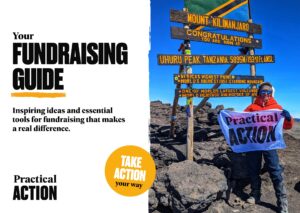
    The views as we walked around the rim of the crater were amazing. Looking to my right, I looked deep into the crater below, and to my left was a huge glacier. Then finally, looking straight ahead I saw the sign that we had been aiming for stating we had reached Uhuru Peak, 5895m AMSL. Walking up to the sign, it didn’t quite seem real that we’d made it. 30 out of our group of 32 made it to the summit, which is a pretty astonishing achievement, and a testament to our brilliant guides. I felt gutted for the two how hadn’t made it to the top and spoke to them both as soon as I made it back to camp. One girl was too ill to attempt the summit night trek, so had stayed in her tent and the other had made it to 5200m and turned around after fainting six times, clearly the right decision and one she did not regret in the slightest. At the top the 30 of us along with our guides hugged congratulated each other, took in our achievement and posed for a photo or two.

    I had joked on the way up that, as far as I was concerned the trek ended at the top and that I wasn’t thinking passed reaching the summit. I would soon learn that, that wasn’t the case and in many ways going down was as much of a challenge, but that I will save for another day.

    If you want to see a few more of my snaps from the trek, then you can see them here, any comments welcome.

    No Comments » | Add your comment
  • Kilimanjaro: Not a walk in the park

    Just over a week ago I wrote a blog as I was preparing for a once in a lifetime adventure (and as you read on you’ll learn why it will certainly be a once in a lifetime adventure). I was preparing for a trip to Tanzania to climb Kilimanjaro, packing my bags and scaring myself by reading up on altitude sickness. I got off the mountain two days ago and still haven’t recovered, I’ve just gone for a walk round the block of my hotel in Nairobi to try and loosen off. Stairs are still a big issue. Back in the comfort of my hotel room I shall give you a short account of my Kilimanjaro challenge.

    Pre-Mountain
    On Saturday morning, we landed in Kenyatta Airport in Nairobi and were loaded onto a couple of buses as we transferred down to Arusha. The journey would be about six hours including crossing the border at Namanga. There was a sense of nervousness when a huge mountain came into view after we crossed the border. This feeling was heightened when our driver pointed out that was only Mount Meru which stands 1330 metres shorter than Kilimanjaro. We arrived at our hotel in Arusha late afternoon and had a briefing from our two Lead Guides, Isaac and Eli (pronounced Ellie). All briefings were only ever for the following day so that we did not get overwhelmed by the enormity of the challenge ahead of us. We prepped our kit, ensuring we had everything we needed, enjoyed dinner round the corner before an early night.

    Day 1
    The day would start with more travelling: along with our team of guides and porters we piled into a couple of buses for the three hour drive to Machame Gate. We signed in at the gate and got the necessary pre-departure team photo. At this point we didn’t feel too much like a team, but we would gel into one very quickly. Machame Gate is 1800m AMSL (Above Mean Sea Level), so we would START our walk nearly 500m higher than the highest point in Britain.

    Our first day’s trekking would see us climb 1300m through rainforest, many of the group saw monkeys but I was never in the right place at the right time. We would camp at Machame Camp, still within the forest, and enjoyed a meal prepared by our skilled chefs. It had been a long day and I felt particularly stiff after a total of about 20 hours traveling before the walk, so I was very happy to bed down on my particularly comfortable sleeping mat.

    Day 2
    We were woken up at 6:20, so that we could get a good early start on the day. Even though we were over 3000m AMSL it would still get warm within a few hours, so an early start was essential. After the almost claustrophobic feeling of the rainforest, the views to be seen on day two were awe inspiring. We moved above the tree line fairly early in the morning and  so we had brilliant views above the African Savanna. We would camp at Shira Camp, the coldest camp of the trip as there was no shelter at all. This did give me the opportunity to get a photo of the camp under the stars as people wandered about with head torches on.


    Day 3
    One of the biggest challenges of climbing Kilimanjaro is dealing with the altitude. I usually wake up at about 50m AMSL in Warwickshire, on day three I woke up at 3850m AMSL and would pass Lava Tower at 4600m AMSL. To acclimatise to the altitude, you climb high and sleep low. So although we would climb 750m by lunch time, we’d then descend 650m after lunch to camp at the base of Barranco Wall. Although we knew it was all part of the plan, it was quite depressing walking so far downhill when we were climbing a mountain. When we made it to camp, it was very clear to see what the next morning had in store for us as we were camped at the base of the intimidating Barranco Wall. As the sun went down our attentions turned from The Wall to one of the many brilliant sunsets from the trek. This trip is the first time I’ve been able to experience a sunset from above the clouds.

    Day 4
    Throughout the trek we had a huge support team of guides, chefs and porters who made the whole thing possible. Some porters carried our main backpacks (on their heads) and others carried the communal kit, such as tents, cooking equipment and even toilets. This feat was made all the more impressive as they left camp after us, overtook us and arrived the next camp before us. They were astonishing. Climbing Kilimanjaro would simply not be possible without them.

    We woke up at 6am to ensure we were able to be trekking by 7am. We had to start so early so that we could have got over Barranco Wall before the porters (both ours and those from other expeditions) needed to pass us. It certainly was quite a scramble with intimidating drops meant you had to stay so close to the rock, wandering towards the edge just wasn’t an option. I’ve highlighted the exact route we took.

    The day would continue with more ascents and descents finishing mid-afternoon at Barrafu Camp (4600m AMSL). We had a very early dinner before bedding down for some much needed sleep at 5pm.

    Knowing what was ahead of me, it was surprising that I slept beautifully.

    To be continued…

    No Comments » | Add your comment
  • There is a light that never goes out

    Watching Mo Farah sprint to a glorious second gold medal in the 5000m race last Saturday night, I felt overwhelmed by a sense of awe.

    I had read a newspaper interview earlier that day with Mo’s elder brother, Faisal Farah, who lives in Somaliland (a self-proclaimed independent state which remains unrecognized internationally), and works on his farm nestled deep in the African savannah. Although I knew the basic details of Mo Farah’s life – Somali-born, lived in the UK since childhood and hugely philanthropic – the interview with his brother was an inspiration.

    Mo was born in the Somalian capital of Mogadishu. Although his father was a businessman, and his family lived a life of relative middle-class comfort, the political chaos soon saw Somalia hurtle into a brutal civil war lasting over 20 years. Mo’s family, who originated from Somaliland, were forced to flee back to that region. And once there, they lived in an IDP camp.

    When I was in Sudan I interviewed several people who had lived for many years in IDP camps – places for ‘internally displaced persons’. An ‘internally displaced person’ is someone who flees their home, but not their country. Someone who crosses borders to escape becomes a refugee. But whether you’re an IDP or refugee, life is difficult. The camps are places of little dignity – so many people squeezed into tiny tents – and there is no way of making a sustainable living, so you survive on hand-outs from aid agencies.

    Imagine that – Mo Farah, double gold medal winning Olympic athlete – spent his early childhood in a refugee camp in the middle of a warring country. There would have been no water, no decent toilets, no proper houses, no schools, limited medical help. And he’s somehow gone from that – from hell – to record-breaking sporting achievement and worldwide adulation.

    I can’t stop picturing all the millions of little children around the world who are currently living in hell. Maybe they are trapped in the blood bath that is Syria, or dying of hunger in the Sahel. Think of all the future Mo Farahs among them. Think of who they could be, of the lives they could have.

    I hope against hope that, like Mo Farah, all those children someday have the opportunity to move on to a brighter life – to a life where existence is more than simply a battle to survive and keep body and soul together, but where you can fulfil every little bit of your potential, follow every dream you have, light all of your hopes.

    End note: This day last year I was in Kenya. I’d spent two weeks visiting Practical Action’s work across the country and was getting ready to go home. I woke up on the morning of my final day in Nairobi hugely excited about my last field trip, to the library and community centre built by Practical Action in Kibera, the huge sprawling mass of a slum just outside the city centre. And then I discovered – via Facebook – that my grandfather, Michael, who had suffered from Alzheimer’s for many years, had died. Michael was a man who spent his life playing and watching sport, in awe of athletic achievement. I know he would have loved Mo Farah. He was a reluctant hoper – but a hoper nonetheless. We need more of them. So this one is for my Grandad.


    No Comments » | Add your comment
  • Kilimanjaro: Why would you do it?

    Jamie Oliver
    August 9th, 2012

    It’s nearly time! On Friday evening I’ll fly from Heathrow to Kenyatta International Airport to join a group from Manchester as they attempt to climb the highest freestanding mountain in the world, Kilimanjaro.

    To say I’m nervous would be an understatement. I’ve got an empty feeling in my stomach and when I think about it I can feel a small, but tight knot somewhere in my gut. I’ve done challenge events before, run half marathons and a marathon, jumped out of a plane, hiked out of the Grand Canyon and even completed Tough Guy a few times, so the empty feeling in my stomach isn’t due to the physical challenge. Nor is it due the travel, I’ve spent time in East Africa before and I am so excited to return. No, the metaphorical moths doing laps of my stomach is caused by one word… altitude.

    We need oxygen, so it’s a good thing that the air is 21% of the stuff. When at altitude the oxygen percentage stays the same, but there’s just a lot less air. In fact, there’s about 50% less air at the top of Kilimanjaro than I’m used to in nice flat Warwickshire. So this lack of oxygen makes everything harder and that’s when altitude sickness can set in. Altitude sickness sounds grim, symptoms range from a light headache and nausea to in extreme cases pulmonary or cerebral edemas. As Kilimanjaro stands proud at 5,895m it is defined as being at extreme altitude and if you’re badly affected then there is no option but to get lower, fast. So what are my chances of being affected by altitude sickness? In all honesty, I have no idea. There is no way of telling whether you’re going to be affected or not, you could trek to altitude five times and be fine, and then on the sixth be badly affected. It all seems like a great unknown to me.

    It therefore seems mad that this summer we have hundreds of students willingly choosing to take on the challenge of climbing Kilimanjaro and fundraising huge amounts of sponsorship along the way. I am really looking forward to finding out what has driven the different members of our team to take on such a challenge. I’ll be doing my best to blog my experiences, so feel free to come back and have read about how I get on.

    No Comments » | Add your comment
  • Charity or justice?

    I’ve been very short-sighted since I was 8 years old. An optician seeking somebody to blame told me it was my own fault – I’d read too many books when I was younger. As my mum is also very short-sighted, I think it was more a case of bad genes.

    So for the last 17 years, I have worn contact lenses and glasses. There is nothing more excruciating than losing a contact lense behind your eyeball, and nothing more infuriating than losing your glasses in the middle of the Indian Ocean when you’re on holiday. My short-sightedness has meant a lifetime of horrible eye infections, irritated eyes after long days of writing, and innumerable pairs of lost lenses and glasses.

    Six months ago, after a particularly severe eye infection, I was told by an eye specialist that I would never be able to wear contact lenses again. I have spent the first half of 2012 wearing very big glasses. They were cool glasses, but mostly they felt like a huge barrier: between me and the rest of the world. So I decided to do something about it.

    12 days ago my life was utterly transformed by laser eye surgery.

    Waking in the morning and being able to see – actually see – the world in all its magnificence feels miraculous. Everything is more beautiful, more colourful, more perfect than before. I have had 12 whole days of 20/20 vision but it still seems unreal, as if tomorrow when I wake, my world might be a sleepy blur once more. I feel so overjoyed – and very lucky – that modern day technology has fixed my broken eyes.

    When I was in Sudan I met a woman, Randa, who also couldn’t see. But her poor vision was nothing to do with short-sightedness. She was going blind because of the smoke caused by cooking on an open fire in her kitchen.

    Randa is from a small village in North Darfur called Kafut, and has cooked with wood for her whole life. This means walking for maybe three or four hours to collect firewood, which she then carries on her head.

    Cooking with firewood means that Randa’s whole house is constantly polluted by toxic smoke. Her house is made of hay, and the inside is burnt black. Randa’s lungs are also blackened by smoke, and like all the other women in her village she has suffered from countless chest problems.

    But the cruelty of the smoke is that it is stealing her sight, and Randa is beginning to go blind.

    Since working with Practical Action, Randa has been introduced to a new kind of cooking, using a stove which uses a clean energy source: liquid petroleum gas. The benefits of this are multifarious: not only is it cheaper for families, it also reduces the pressure on the dwindling supply of trees in North Darfur.

    But for Randa, the most wonderful thing about her new stove is that it does not aggravate her eye problems:

    “The LPG stove has totally eliminated the smoke… I think it has saved my sight. Before my eyes would stream constantly but now this has stopped. And I can breathe easily.”

    Randa belongs to the Women’s Development Association in her village, and she is now educating other women about the benefits of cooking on an LPG stove, and also helping to distribute 19 stoves to families across her village, and 61 to other communities nearby.

    Meeting the beautiful, determined Randa , and listening to her story, confirmed to me that simple technologies – such as a new stove – really can be life-changing. I know Randa was thrilled that the stove had saved her sight.

    But how I wish that she’d never had to lose it in the first place. And that like me, she could benefit from wonderful new eyes.

    What fills me with fury is the injustice of it. Because Randa’s near-blindness wasn’t inevitable. It need not have happened. I know that Practical Action’s work is helping her now, but for thousands of other people, it’s already too late.

    Nelson Mandela once said “overcoming poverty is not an act of charity, it is an act of justice”. I think he is right.

    We are not being charitable by helping. We are helping to restore some sense of justice to this world of ours that is so unbalanced and just so unfair.

    5 Comments » | Add your comment
  • Hope and love and unity and perseverance and people

    I am not a cynic by nature. Yet something about the London 2012 Olympics has unearthed a curmudgeonly Ella Jolly who I never knew existed.

    The knowledge that £9 billion of taxpayers’ money has been spent on the Olympics – at the expense of other public spending – while usually austere politicians feebly reassure the British people that putting London on the world stage will ultimately be ‘good for growth’, fills me with fury.

    Each time I walk through Euston station in London, which is plastered with McDonalds adverts screaming hollowly “We all make the games”, I feel so outraged that this sporting event is sponsored by a multinational corporation whose insatiability contributes to the obesity epidemic across the western world.

    And although communities across Britain participated in the monumental Olympic torch relay, the Games themselves still feel so London-centric. Walking round Oxford Street this weekend, the Olympics were omnipresent – in all shop windows, billboards, tube announcements. Back in sleepy Warwickshire that heady excitement seems a little distant.

    So as I settled down last week to watch the Opening Ceremony on Friday evening, I was fully anticipating feelings of cynicism or anger or embarrassment or disappointment.

    Instead, my own heart surprised me, and I felt moved, entertained, humbled, and full of joy.

    I do not have a patriotic bone in my body – last year’s Royal Wedding and this year’s Jubilee Celebrations left me feeling strangely numb – yet the Great Britain that Danny Boyle, the director of the ceremony, presented to the world, was a Great Britain that felt like mine.

    It rejoiced in the rural and the urban, the simplicity of a bygone pastoral age and the connectedness of our own digital era, and crucially, it made heroes of normal everyday British people – the performers were all volunteers. It hailed all the wonders of Britain – the NHS; our rich literary heritage from Shakespeare and Milton to J.K. Rowling and J.M. Barrie; our incredibly diverse music: David Bowie, The Rolling Stones, The Beatles, The Arctic Monkeys, Dizzee Rascal; that singularly British sense of humour, and the power of youth and hope.

    It celebrated love, with Paul McCartney singing “and in the end, the love you take is equal to the love you make”, and unity, with Tim Berners-Lee (inventor of the internet) tweeting live “this is for everyone”. Love and unity.

    And as the competing Olympic athletes processed round the stadium, I felt so proud to see representatives  from Kenya, Sudan, Zimbabwe, Bangladesh, Sri Lanka, Nepal, Peru – countries where Practical Action endeavours to work in partnership with some of the poorest people to make their lives a little better. I am sure that those athletes have had to persevere against the odds to secure a place in London 2012.

    In a Practical Action blog last week, my colleague Mansoor posed the question “do the Olympics and our efforts to fight global poverty have a relationship?” and anticipated an Opening Ceremony about oneness and our diverse unity. Mansoor was correct I think. The ceremony was indeed about unity and diversity. And it was also somehow – amazingly – both uniquely British, and cosmically human. I think that’s why I loved it.

    That feeling of cosmic humanity is absolutely fundamental in our efforts to fight global poverty.

    All too often development is considered an academic pursuit, with the people living in poverty all too often anonymous beneficiaries. For me, development is not academic. It is personal. It is about people. And they are living, feeling, thinking human beings with their own stories. And I don’t think we can ever afford to forget that development is, ultimately, about people.

    Danny Boyle’s Opening Ceremony not only made me glad to British, it made me glad to be human. And it made me believe. It made me believe in hope and love and unity and perseverance and people. And I think in order to fight global poverty we all need to believe.

    4 Comments » | Add your comment