Stop Press……Practical Action challenges fairy godmother’s pumpkin transformation abilities
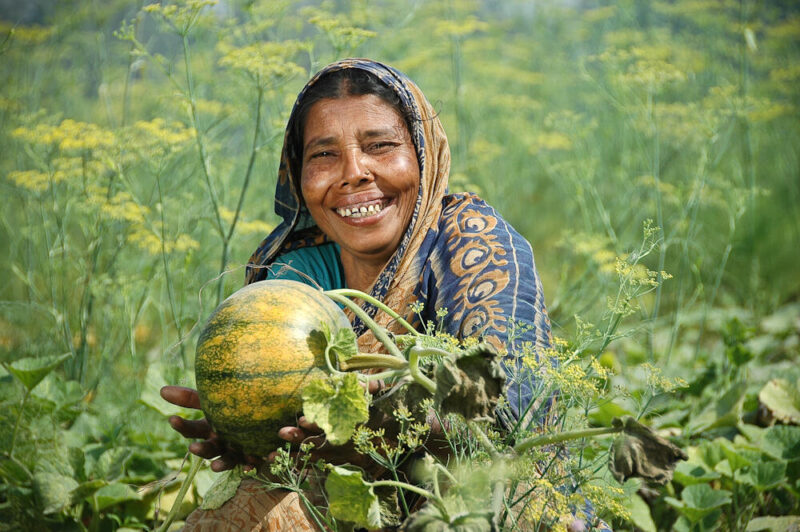
We all know the story of how Cinderella’s fairy godmother changed a pumpkin into a golden carriage to take Cinders to the Ball – Practical Action is turning this humble green vegetable into food, livelihoods and secure futures for thousands of families in Bangladesh.
Practical Action’s Bangladesh team is changing the lives of some of the poorest people living on the shifting margins of Bangladesh’s great rivers, where the increasingly severe and regular floods are displacing thousands of extremely poor people each year.
After the rainy seasons, large sand islands, deposited by the floods, appear in the main rivers of North West Bangladesh. These islands although common property had never previously been used for productive purposes until Practical Action experimented with planting pumpkins. A small hole is dug, the bottom scattered with a small amount of compost and urea, the pumpkin seed planted, and (almost!) as quick as a wave of a wand, the pumpkin plants grow, thrive are producing wonderfully large, green pumpkins.
Not only are the pumpkins nutritional for families who previously had neither the money or permanent land on which to grow food, but they can be stored for over a year, providing food in leaner times, and their longevity and robustness makes them ideal for transporting to distant markets.
Since the project started in 2005, over 10,000 people, mainly women, have produced 55,000 MT of pumpkins, worth over £5m and more and more communities are taking up the technology. The project has also been recognised for its innovation and impact, having recently been shortlisted to the last three for the prestigious St Andrews Prize for the Environment.
Move over fairy godmother!
No Comments » | Add your commentBangladesh Revisited
Sometimes going back can spoil a good memory.
On my first visit to Bangladesh, to Gaibandha in the north, I was taken by boat across a broad, slow moving river to islands of homes created by Practical Action and riverside communities, whose homes, livestock and sometimes lives, were being lost on a regular basis, to increasingly severe flooding.
The project was called, ‘Disappearing Lands’, and had been funded by the Big Lottery Fund. The team worked with the communities to identify the poorest families who were most vulnerable to the floods and created a safe island home for them by building a raised platform of earth, on which were clustered one room homes, with space for a small homestead garden, together with emergency shelters for their livestock for when the floods came. The pleasure and pride these families took in their new homes was evident by their eagerness to show me inside. There was room to store pots, pans, clothes and blankets and a space for the parents to sleep on one side of the room, the children on the other.
Even in the last village I visited, completed only a few weeks before, small homestead gardens had been demarcated and the first shoots of spinach were unfolding. Seeing such obvious pleasure in their new, safe homes, was moving and was a good memory to leave with.
That was four years ago. I’m back again in Bangladesh with Karin Reiter, Group Corporate Responsibility Manager for the Z Zurich Foundation. The Foundation has supported Practical Action’s work with communities in the district of Sirajgonj, also vulnerable to flooding , where extremely poor families have so little that even a small life shock, such as illness, is enough to destroy their ability to survive. So flooding is truly devastating. We’re here to see how the project, V2R (Vulnerability to Resilience) is progressing and what lessons can be learned for the future.
Using the principles and lessons learned from Gaibandha, the V2R project is taking an holistic approach. As well as ensuring people’s homes and livestock are safe from rising water, people now have choices in the way that they can support themselves, so that they are no longer reliant on a single livelihood option, which could easily destroyed by one flood. They are also involved in preparing plans to respond to flooding so that people know what to do in times of emergencies, such as which evacuation route to take, where the shelter areas are, and how to ensure the safety of their livestock. And when the rising waters isolate them, they have the means, in an emergency, to transport a seriously ill person to a hospital using an ambulance boat.
We visited a cluster village, now home to 25 extreme poor families. We were shown round neat rooms, with outside cooking areas, and access to clean water with tube wells. They also have thriving businesses such weaving, crocheting and tailoring, as well as raising chicken and ducks, and the newly introduced rabbits – a sure-fire high production product!
What struck me most forcibly is that it’s the women who are the running these businesses and their confidence and determination is inspiring. With the money they’re making, they are paying for their children’s education, investing in their businesses and putting money by for emergencies.
There are still issues to be solved – how to provide affordable and sustainable energy, for example, to the communities (ensuring technology justice) – but the partnership between the Z Zurich Foundation and Practical Action is changing lives for the better for many children, women and men living beside the river in Sirajgong district, and the good memory of Bangladesh, and the impact of Practical Action’s work, remains very firmly intact!
No Comments » | Add your commentReturn to sender – address unknown
Return to Sender – address unknown
As the Elvis Presley song goes. Despite email, for most of us the idea of not having a physical address to give someone is unthinkable and it would be almost impossible to function – how would you get a passport, how would you open a bank account?
I’m a bit of a serial house mover, probably around eight houses in the last 30 years, not counting friends’ spare rooms, rented accommodation, etc. I love the whole process of house hunting, moving in, planning the decoration, spending contemplative evenings with the radio and paint brush, and then just when it’s all tickety boo, I find myself cruising the estate agents’ websites, checking out what ‘doer uppers’ are out there. This all comes at a price of course, letting people know that you’ve moved and then the irritation when an important piece of correspondence goes awry. But I have to remind myself, at least I have an address.
A completed cluster village
Back in 2009, I visited Bangladesh, to see Practical Action’s ‘Disappearing Lands’ project in Gaibandha, where we were working with communities forced by their poverty to live on land at the edge of the rivers, land not wanted by anyone else because of the increasingly regular and severe flooding following monsoon which shifted the soil. As a result, each monsoon left them vulnerable to loss of crops, livestock, homes, and sometimes their lives. With Practical Action’s support, cluster villages were constructed on soil platforms built by the communities, raising their homes above the flood line. These cluster villages provide housing, gardens, schools, clinics and emergency shelters for livestock for when the monsoon season arrives. One of the cluster villages I visited had just been completed, but already gardens were fenced, crops planted, and people were busy setting up craft businesses to earn additional income. Amongst this busy, thriving community, I met a grandmother, standing in the doorway of her new house. She wanted to share with me her delight in her new home. That I completely understood! But what surprised me was her great excitement and immense pride in having an address. I just hadn’t thought about it before. For her, having an address meant that she existed, she lived somewhere permanently, she could tell someone exactly where she lived that day, where she would be next year, and hopefully for the rest of her life. Having an address gave her kudos.
I’m visiting Bangladesh again in a couple of weeks with a great Foundation, Z Zurich Foundation, which has supported our project, ‘Vulnerability to Resilience (V2R)’, for almost five years, continuing our work with communities in flood prone areas. I’m looking forward to seeing many of the ideas from our Gaibandha project helping others to finally have an address.
No Comments » | Add your commentHobbits, Hyacinths and Happiness
Hobbits, hyacinths and happiness
Who would’ve thought that hyacinths and happiness would go together so well? But they do in flood prone Bangladesh. Practical Action works with some of the poorest people, forced by their poverty to live on land that shifts with the annual floods, so nowhere is ever really home, and making a garden is an act of faith. With water comes water hyacinth in abundance, a weed which Practical Action helps communities turn into floating gardens – an example of a really simple technology that works wonderfully well. The hyacinth leaves, supported by bamboo poles, are woven into a bed, on which is laid soil, into which seeds for lettuces, okra, sweet onions, pumpkins, etc., are planted. The plants’ roots reach down through the hyacinth bed to the flood waters, and nature does the rest. What could be simpler? It doesn’t have to be just hyacinth leaves; any material can be used to create a floating garden in this way, enabling food to still be grown when floods make normal planting impossible, bringing happiness to communities who previously struggled to meet their families’ food needs.
This is just one example of a project which Trusts and Foundations are helping Practical Action implement….and we have many more for which we need support. If you’re a Trustee of a Trust or Foundation and would like to know more, contact me on Liz.Frost@practicalaction.org.uk.
And the hobbits? They don’t have anything to do with floating gardens I’m afraid, but being keen gardeners themselves and enjoying at least six meals a day, I think they would really approve of such a simple but productive technology.
No Comments » | Add your commentLife after confronting the abyss
Could better market systems help people rebuild their lives after the disaster of river erosion?
Jashim, Mahbub and I drove to Jamalpur in northern Bangladesh this morning. It was a fine cool morning with sunlight dappling the tree-shaded road – and plenty of activity to admire in surrounding fields, fish-ponds and homesteads. After crossing the mighty Jamuna river near Tangail, we took a relatively minor route snaking along tree-lined embankments between paddies rich with fields of winter rice and freshly planted vegetables. The road was busy with bicycles, rickshaws and small lorries laden with jute, but it was a relief to have few of the heavy trucks and careering buses that terrorise the main road to Dhaka.
An hour after crossing the huge river, we entered Sorishabari near a village called Amtola. Suddenly I was surprised to find the road almost walled-in by sheets of corrugated iron assembled on wooden frames. Walls inset with shuttered windows, and bricks stood piled at the edge of the tarmac. I realised I was looking at dozens of flat-packed houses, stacked more or less neatly at the side of the road, like goods in some unlikely, out-sized IKEA warehouse.
Walking between homes a few yards from the road, we stumbled out of the trees onto a desolate scene. Fertile fields ended abruptly at a plummeting edge: the freshly eroded bank of the river. All around, the sad remnants of homes – foundations torn, walls razed, a lonely tube-well, the pathetic remains of a kitchen hearth. A neighbour explained that the families had desperately demolished their homes to save the materials from the encroaching river. “How far has the river bank moved this year?” Jashim asked. “Two kilometres!” the man replied. “It obliterated four villages.”
Later I learned that during an unprecedented third flood event this summer, the main flow of the Jamuna river unexpectedly changed course at this point. It rapidly ate into land that must have felt safe-as-houses to its residents only weeks earlier.
We moved along the bank a small distance, and met a family whose home, but little of their land, had just about survived the summer erosion. An old man, Razib, and his two sons greeted us warmly – optimistic perhaps that this visiting foreigner was an omen of assistance. The women kept a discrete distance. A young deshi cow and her calf were tethered to a wicker manger full of rice straw, and a couple of fat chickens scavenged as close as they dared to a modest harvest of rice drying in the sun. The bank here was crumbling and vertiginous. I could imagine it too, collapsing and sliding in moments into the muddy abyss twenty feet below. How do they sleep at night?
“What are you going to do?” we asked. The old man pointed through the midday haze – over the abyss at his feet and half a mile across the water – to a vast island of sand and silt emerging mid-river. “We will move there, and start again – on the chars.”
Chars is the Bangla word for the sand-banks, mud-flats and islands that form and re-form in the great rivers of Bangladesh: the Jamuna, Padma, Teesta etc. They accumulate during the summer from eroded sediment washed downstream by monsoon rains, and emerge as the flood-water recedes – sometimes forming islands that endure for ten or twenty years before the meandering river consumes them once more. In recent decades, as population pressures on the mainland have grown, chars land in northern Bangladesh has become refuge and home to more than two million people – mainly victims of river bank erosion. They usually arrive with barely any assets.
Rebuilding a farming livelihood on the chars is desperately hard. Having lost any land they held title to, migrating families are frequently at the mercy of local mastaan (or muscle-men) linked to ‘influential’ land-owners and political chiefs, who control the new chars land. Land must be leased (or share-cropped) from often ruthless ‘land-owners’. Most terrain is liable to flooding during the summer months, but due to low water-retention of the sandy soils, also prone to drought for half the year. Men often have to migrate seasonally to cities and richer agricultural areas for work, leaving women-headed families vulnerable to abuse. Meanwhile, the displacement that drove most households on to the chars often disrupts the social networks that women in poorer households rely upon for mutual support.
On young chars, especially, there is usually no infrastructure: no roads, no schools, no medical facilities, no irrigation, no electricity nor other basic services. Transport of goods to and from markets is expensive and slow. In the summer, when waters are high, boats ply between the chars and ghats (landing stages) on the mainland. The ghats too are controlled by mastaan, who levy taxes of their own devising on the farmers and traders. When the river recedes, transport options are usually worse – with char villages often stranded far from the water’s edge across baking stretches of trackless, sandy soil. As a result, despite large (seasonal) expanses of land, markets for agricultural inputs and services are feeble, the economic output of chars land is low and the poverty of most households is intense.
My companions on the journey today, Jashim and Mahbub, are project officers for a recently started poverty-reduction programme called M4C. Making Markets Work on the Chars – a five year joint-initiative between Practical Action Bangladesh, Practical Action Consulting and Swisscontact, that is paid for by the Swiss government (SDC). We were on our way to Jamalpur to help run a workshop that brought together char farmers (like Razib), input suppliers, traders and agricultural service providers to explore how these diverse ‘market actors’ might work out practical solutions to some of these challenges. The workshop used a process called Participatory Market Mapping: creating a space for people, who do not normally talk on equal terms, to understand each other, discuss how different crop sectors (maize, chilli, jute etc) work, learn what each others’ needs and problems are, and begin to build trust and explore different ways of doing business together to make these ‘market systems’ work better – particularly for poorer farmers.
Unlike many donor-funded projects, M4C will not be handing out money or goods to poor households. It will instead be supporting and relying on the char farmers’ capabilities to work out mutually-beneficial solutions to their problems: to work out better deals with each other, and involve the private sector in innovative ways. Helping farmers work out how to coordinate and bulk up their production is one clear opportunity – since this quickly reduces transport costs for input suppliers and traders, and gives them a good reason to enlarge their business activities and provide better services on new chars. This is a key step in enabling chars households better access to income and opportunities spilling over from expanding markets in the thriving towns and cities of the ‘mainland’.
It take time for people to build trust and devise new ways of working together effectively. M4C’s approach is not instant palliative relief, but a long-term strategy for transforming access to services and income opportunities on the chars. We believe that initiatives that stem from farmers’ and other market actors’ own ideas, and that align naturally with their interests, are much more likely to endure, and spread spontaneously to other locations. Entrepreneurial traders, input-suppliers and service providers will copy business ideas that work, taking good ideas to new chars, and extending the impact of our work far beyond what we could ever achieve directly. With this vision, M4C is geared to achieving changes that are intrinsically long-lasting and reach significant numbers of poor households.
1 Comment » | Add your commentA new challenge!
If you are a teacher and have used any of our STEM challenges before we are sure you will love our new one……The Floating Garden Challenge designed for ages 7-19.
Give your students a global problem and ask them to solve it.
The problem: In Bangladesh land is frequently flooded as a result of climate change, ruining crops grown for food. The result is that families go hungry
The Challenge: To design and make a model solution to the problem that will enable farmers to grow crops even when the land is flooded.
Students test their models to see which one holds the most weight when floated in water then look at how Practical Action has worked with communities in Bangladesh to build floating gardens out of local, sustainable material…. an example of technology justice in action.
Perfect for STEM and science clubs, NSEW, collapsed curriculum timetable days as well as for enhancing a lesson on forces.
Resources to help you deliver the challenge are free and include a PowerPoint, teacher’s notes, student worksheets, certificates and a beautiful A2 poster which you can request free. All materials are available in English and Welsh.
Go to practicalaction.org/floatinggardenchallenge
A little small is beautiful, lots of inspiration – and many wonderful people
Although I have been very, very lucky to have had the opportunity to travel to Kenya and Sudan to visit our projects, I have not visited all of Practical Action’s countries of operation. I have hundreds of colleagues who, sadly, I have not been able to meet in my three and a half years working for Practical Action. We communicate through email and Skype, and although these technologies promote good working relationships, nothing beats having a real conversation in person.
So last week it was a real joy to meet one of Practical Action’s most dedicated project workers, Nazmul Islam Chowdury, from Bangladesh. Nazmul is currently visiting the UK as part of our work campaigning for more political action, leadership and funding for the fight against climate change.
Nazmul is truly inspirational. We speak at length about the Pathways from Poverty project which he manages in Bangladesh. This ambitious project, one of the largest in our history, endeavours to help 119,000 of the poorest women, men and children in rural areas of the country to take the first step to a life beyond poverty.
Many families here are achingly poor, and have been impoverished for generations. Their poverty is not just a shortage of money with which to buy things. It means starvation, dirty water, ill-health, inadequate shelter, limited access to education. It is the lack of sufficient resources with which to keep body and soul together.
At the beginning of the Pathways from Poverty project, people had lost hope of things ever being different or better. Nazmul’s assurance that, within 12 months, communities would have enough food to overcome their hunger was met with huge suspicion. That suspicion only intensified when Nazmul shared his idea of a beautifully simple farming technique, sandbar cropping, which could secure food for life. “People thought I was mad!” he says.
Floods in Bangladesh don’t just destroy homes and lives when they arrive; they also leave a crippling legacy when the waters subside. The ‘char’ – the silted sand plains that the floods leave behind – are too infertile for even the most skilled farmers to tend. Nazmul’s idea was to simply dig holes in the sandy plains and fill them with manure, compost and then plant pumpkin seeds. Within seven days the pumpkin seeds start to germinate fresh green shoots. And hope springs once more.
“I remember one woman in particular who was so delighted with her pumpkin harvest. She told me ‘I’ve fallen in in love with this. Before I hated spending time in the field because it seemed so futile. Nothing grew. But now I want to spend all my time tending to my crop of pumpkins. I’ve never seen so much food. This technology is helping us to grow food in the sand. It’s a dream.’ Listening to stories like this makes me feel immensely proud of the sandbar cropping technology. I think it is the best example of ‘small is beautiful’.”
The Pathways from Poverty project is already having a huge, transformational impact on the lives of some of Bangladesh’s most desperate people.
I ask Nazmul what drives him, and am so inspired by his response:
“I feel a great sense of responsibility to the Bangladeshi people. Everyone pays their taxes. And those taxes have paid for my education. I feel it is my duty to pay people back. I use this philosophy to inspire my team. I want to see people in my country enjoying their lives, not spending every moment worrying about their survival, about their children’s survival. We may never be rich like the Americans. But I want to ensure that everyone has the opportunity to earn what is sufficient for life. Everybody in the world has the right to food, shelter, and education, healthcare. These are the basic rights and choices.”
As I listen to Nazmul’s words, I feel so immensely lucky to work with such visionary people who are so committed to challenging the numerous injustices in our world. Practical Action is an organisation, but our good work is only possible because of people – our committed team of project workers, the people with whom we’re working who revolutionise their own lives, and of course, you – the lovely, wonderful people who support us.
No Comments » | Add your commentBridging the gap between Bangladesh and Britain
I’ve been kept pretty busy during my visit to Belgium and the UK attending a series of events on climate change adaptation. I’ve been to many different places and met a wide range of people. The journey started in Brussels.
1. The European Commission

I met with Dr. Costa Papastavros, Senior Environment Officer for Cyprus, current holders of the presidency of the Council of the European Union. This meeting was facilitated by CAN Europe in Belgium and focused on future funding for climate change adaptation work. Like Bangladesh Cyprus is keen to see adaptation go up the UNs agenda as it is increasingly suffering from drought and water shortages due to climate change. Dr Papastavros was keen to hear about the reality of the situation on the ground and about technologies for adaptation tried and tested by Practical Action in Bangladesh. He promised to help us to push this up the agenda at Doha.
2. The European Parliament

Floating gardens help people grow food during periods of flooding
I spoke at an event in the European Parliament entitled ‘What can we realistically expect out of the climate change talks in Doha’? It was hosted by theUK MEP Linda MacAvan, the spokesperson on climate change for the Socialist and Democrat Group. Also in attendance was EU Director of Climate Strategy, Artur Runge-Metzger. Arthur initiated a discussion about the climate talks and I followed up with a presentation on how extreme poor communities in NW Bangladesh are adapting to climate change through Practical Action’s Pathways From Poverty Project.
No Comments » | Add your comment
Way outside my comfort zone

Why on earth did I agree to do this? Surely I must be old enough to know better! These were the thoughts running through my mind on Thursday, as I stood outside a London tube station clad in wetsuit, mask and snorkel engaging with bemused members of the public. Why, you may well ask?
Many areas of London near the Thames are likely to be underwater by 2100. A small group from Practical Action were handing out tube maps showing what London might look like then – hence the scuba gear.
Londoners fortunately have time to prepare for this but for the people of Bangladesh the crisis is already unfolding. Bangladesh is one of the poorest countries in the world and already half of the country can be inundated during the floods.
At an event in County Hall tonight Nazmul Chowdhury will be talking about his work with some of the poorest people in Bangladesh. Nazmul supervised Practical Action projects with communities who face frequent flooding. We are building flood proof housing, embankments and refuges as well as providing training for alternative livelihoods for flooded areas such as fish and duck rearing. Floating gardens and pumpkin growing are two of our proven technologies which help people to adapt to the changing climate.
But much, much more needs to be done. Millions of people facing the effects of climate change in Bangladesh should have a chance of adapting to a future of more severe flooding. Currently, less than 10% of climate finance is spent on adaptation – we want this to increase to 50% - join our campaign on Twitter to apply pressure.
No Comments » | Add your comment