Disaster risk reduction and climate change
Practical Action Nepal
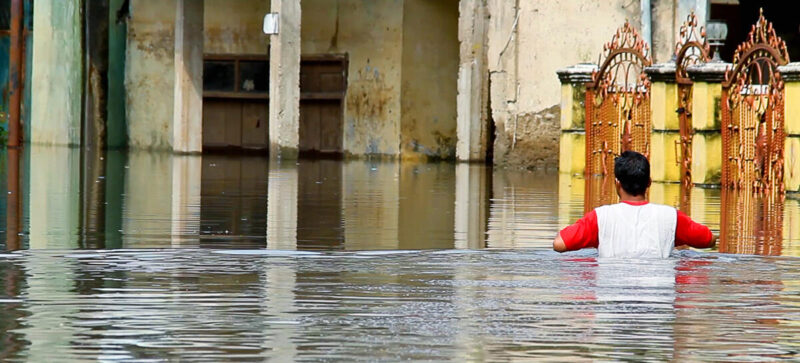
Nepal is prone to natural disasters due to its geographical and climatic variations requiring different coping strategies to minimise the negative effects. The vulnerable groups, mainly poor people from the rural and urban areas, are in a dilemma of economic hardship, insufficient knowledge on disaster management, low literacy rates, inadequate physical infrastructure, poor forecasting facilities and unplanned settlement. This situation leads to a number of frequent problems related with the livelihoods of the vulnerable people. The hardest hit is the agricultural sector.
Practical Action Nepal's Disaster risk reduction and climate change programme aims to reduce the loss of lives and property of vulnerable communities due to water induced disaster and addresses the impacts of climate change on vulnerable communities by identifying and developing adaptation and coping strategies.
Based on the lessons learned from previous projects in Nepal and consolidating international learning, Practical Action is focusing its work on preparedness, promotion and adaptation of indigenous practices, and the development of early warning systems appropriate for flood disaster. The programme further encompasses
- the adaptation of existing natural resource management practices to reduce the impacts of climate change;
- study of indigenous coping strategies, knowledge and skills;
- adaptation of existing farming system/ ractices;
- strengthening communities’ coping strategies and
- diversifying livelihood options; and establishing appropriate monitoring systems at community/micro level.
Projects
- Mainstreaming livelihood-centred approaches to disaster management
This project aims to enable poor communities to build secure lives and cope better with hazards such as floods, landslides, droughts and wildlife intrusions. - Scaling-up Early Warning Systems in Nepal (SEWIN)
Building on previous experience with early warning systems in Nepal, this project aims to strengthen the capacity of vulnerable flood-prone communities and district authorities in Nepal to understand, mitigate and respond to risk, and benefit through the use of flood EWS.
(for historic work see also Banke Bardia flood warning programme funded by ECHO and application of alternative strategies for community-based flood preparedness, and Strengthening the capacity of communities to manage early warning systems to reduce the impacts of floods)
Recent project work also includes Increasing community resilience to cope with impacts of climate change
Flood warning project highlights 2008-9 | Programme highlights 2007-8
Building embankment boosts farming
Land erosion and deposition of debris due to frequent flooding has left many Bote families in a peril living near the banks of Baulaha River in Nawalparasi District. Among the affected is Sumitra’s (47) family, she lives with her husband, a son and a daughter.
In the last decade, livelihoods of Bote community’s – fishing and ferrying people across the rivers-slowly perished due to river pollution, frequent flooding, and construction of bridges and culverts among others. After much endurance to sustain their livelihoods, like many, Sumitra and her family opted agriculture as their main occupation but unfortunately, frequent flooding has caused them to lose their crops every year forcing them to work as daily wage labourers. “The year 2006 was the most painful one, as the flood destroyed our paddies and deposited debris in our land, I was unable to harvest a single grain of crop,” she recalls.
Sumitra and her family collect and sieve sand and aggregates for selling but the work is very tedious and earns far less compared to farming. Disaster caused by frequent flooding has shifted the settlement of Bote communities (known as Bote Tole) two km away from the main highway. Practical Action in partnership with its local implementing partner - SAHAMATI started implementing DRR project in 2007 along the settlements of Baulaha River. In 2008 winter, communities, project staff and concerned stakeholders agreed to construct a 1.8 km long embankment along both banks of the Baulaha River. The new embankment has helped protect 40 hectares of arable land out of which Sumitra’s family owns one hectare.
“After the project helped us build embankment, we renovated our farms and transplanted paddies. We produced 800 kg last year,” she says. “The produce is enough to fulfill our year round rice supply. There are now other families who have also started cultivating their land.”
Sumitra smiles and further says - “I have received training on different methods of growing vegetables. We consumed the vegetables planted in our 200 square meter yard last season and sold only the remaining and still earned NPR. 5000 (£45). With the money, I bought utensils and spices and have saved half of it for emergency.”
Publications
Early Warning Saving Lives (English, PDF, 1.6 MB)
This publication helps summarise Practical Action’s learning in Early Warning Systems (EWS) and offers practical insight in to how such systems can be replicated and developed elsewhere.
Community Based Disaster Management Plan - Chitwan (Nepali, PDF, 4.98 MB)
The disaster management plan of vulnerable VDCs and a municipality of Chitwan district in Nepal includes separate plans of each 31 village development committees and a municipality. This book is result of series of interactions among communities in the VDC and stakeholders’ workshops in a group of VDCs.
Community Based Disaster Management Plan - Nawalparasi (Nepali, PDF, 4.4 MB)
The disaster management plan of vulnerable VDCs (category 1 and 2) of Nawalparasi district in Nepal includes separate plans of 26 village development committees. This book is result of series of interactions among communities in the VDC and stakeholders’ workshops in a group of VDCs.
Disaster Risk Reduction Policy Brief (Nepali. PDF, 759k)
The document, in Nepali, depicts process of community based disaster management planning at community and VDC level. This is based on the joint work in two districts in Nepal in collaborative efforts of district governments, village governments, projects and NGOs. A more elaborated version is also available in English.
Practical approaches on community based disaster management planning (English, PDF, 487k)
The document provides information on process and methods on CBDM planning based on practical experiences in Nepal. Government and civil society organizations were involved in the process.
Livelihood Centred Approaches to Disaster Risk Reduction (Nepali, PDF, 1.6 MB)
This brief note describes disaster, disaster risk, and its management in the cycle, ie. before, during and post disaster situations. It looks at livelihood assets and how a poverty-pressed family gets into vicious circle of poverty, and how stronger livelihoods provide supports to resilience, before examining activities to enhance livelihoods that enhance resilience capacity of vulnerable families.
Mainstreaming Livelihood Centred Approaches to Disaster Risk Reduction (English and Nepali, PDF, 361 KB)
A project information brochure in English and Nepali, outlining the Mainstreaming Livelihood Centred Approaches to Disaster Risk Reduction project methodology and expected outputs.
Temporal and Spatial Variability of Climate Change Over Nepal 1976-2005 (English, PDF, 5.03 MB)
A comprehensive study of temperature and precipitation of Nepal was conducted to see
the signs of climate change across geographical areas and over seasons. Monthly precipitation data from
166 stations and monthly temperature records from 44 stations for the period of 30 years (1976-2005)
over Nepal were considered in this study. Through the use of these data, temporal and spatial variations
of precipitation and temperature were analysed. Climatic maps were prepared for various ecological zones
and for the whole of Nepal.
Helping the Poorest to Survive- Promoting Adaptation to Climate Change (English, PDF, 1.29 MB)
This paper briefly reviews climate change and its impacts at national and local levels in Nepal, which indicate climate uncertainties are sure in the coming years. The paper also highlights adaptation strategy and areas for action at community level based on the experiences of Practical Action in Nepal.
Shallow Tube Well Construction (Nepali, PDF, 1.3 MB)
This document in Nepali provides information on the construction of shallow tube well by a group of small landholding farmers in the Tarai region in Nepal. It states different methods of boring and accessing technical and financial inputs from underground water irrigation project offices of the ministry of water resources and district agriculture offices in the region. This is based on the DRR project experience while working with communities and NGOs, in Chitwan district in particular. Underground water irrigation project of the ministry of water resources and district agriculture development office in Chitwan provided information on policies and advices to prepare this book.
Further information
- Strengthening the capacity of communities to manage flood early warning systems
- Mainstreaming livelihood centred approaches to disaster management
- Increasing community resilience to cope with impacts of climate change